Fighting Yesterday’s Pollution While Today’s Poison Fills the Air
London’s Ultra Low Emission Zone (ULEZ) was sold as a bold environmental crusade a tough, modern solution to the capital’s dirty air. Drivers were told that once the smoky old diesels were banished and everyone paid their dues, Londoners would breathe cleaner, healthier air.
But several years and multiple expansions later, the reality is awkward: London’s air quality has barely improved, and in some areas, particulate pollution has stayed stubbornly high or worsened. Why? Because ULEZ is fighting the wrong enemy.
ULEZ only targets exhaust fumes, but exhaust is no longer the major source of urban pollution, and really hasn’t been for a very long time. The real villain is brake dust, tyre wear, and resuspended road particles, pollutants that ULEZ does not regulate, measure, or even meaningfully acknowledge.
A wave of recent research has confirmed what scientists have been hinting at for years: most of the health-damaging particulate pollution from road traffic no longer comes from tailpipes. It comes from the mechanical wear of stopping and rolling thousands of cars across London’s road network.
A landmark 2025 study reported by The Guardian found that brake pad dust can be more toxic to human lung tissue than diesel exhaust particles. Modern brake pads shed copper, iron, barium, and other metals, and these microscopic particles linger right at breathing height.
ULEZ does nothing about brake dust. Worse still, the rise in heavier SUV’s, which are mostly “ULEZ-compliant”, means more tyre wear and more brake abrasion. So while compliant vehicles reduce exhaust emissions, they often increase the far more dangerous particles Londoners inhale every day.
Even EVs Aren’t the Clean Escape London Hoped For either. Electric vehicles were meant to be the next step: quieter, cleaner, and emission-free. But even they cannot escape the reality of non-exhaust pollution. EVs are heavier, wear tyres faster, disturb more road dust, and still use friction brakes during high-load stops.
And then came the most surprising discovery of all.
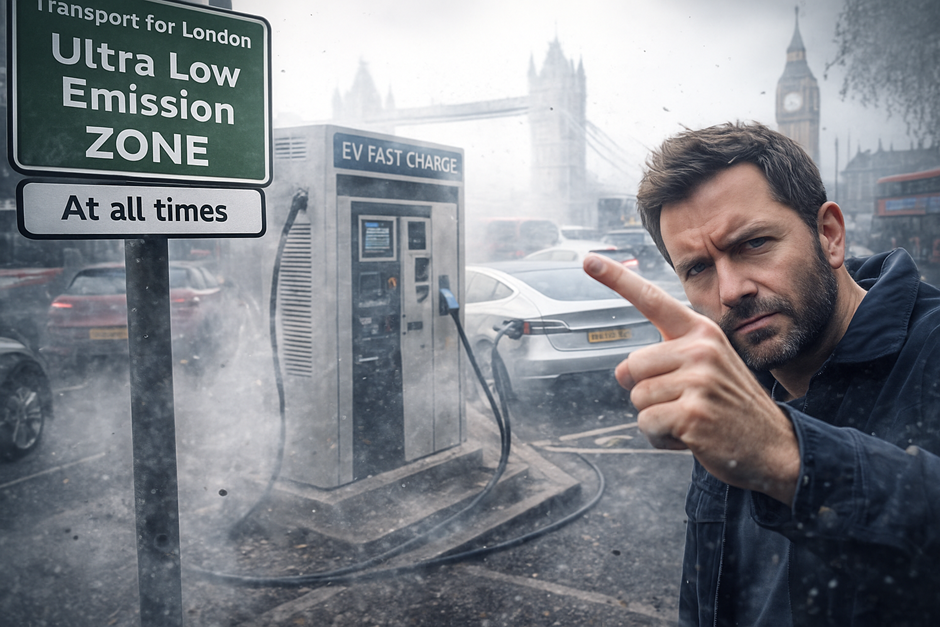
A 2025 UCLA study found that air pollution around EV fast-charging stations was up to twice the normal urban background levels. Not because EVs pollute — but because the cooling fans inside the charging cabinets blast dust, brake particles, and microplastics into the air, creating toxic hotspots exactly where people stand to charge their “clean” cars.
ULEZ, meanwhile, remains laser-focused on exhaust pipes, while ignoring these new pollution volcanoes erupting in car parks and charging bays across the city.
ULEZ isn’t useless, it raises massive amounts of tax for the Government, but it’s also outdated. It tackles a shrinking slice of the problem while the real pollution sources grow unchecked. Tailpipe emissions were already falling due to cleaner engines and stricter standards. Brake dust and tyre wear, however, are rising, and now make up the bulk of road-traffic particulate pollution.
Yet none of this is taxed, regulated, or limited.
ULEZ is a political comfort blanket: visible, expensive, and symbolically powerful, but scientifically incomplete.
The Bottom Line is that London or any city that adopts a ULEZ scheme will never achieve genuinely clean air until policymakers confront the pollution that actually harms people today. That means regulating brake-dust, tyre particles, road-dust, and even EV charging infrastructure, not just the exhaust pipes of yesterday’s cars. Until then, ULEZ remains what it truly is: Just a stealth tax and should be considered as a 2010 solution to a 2025 problem