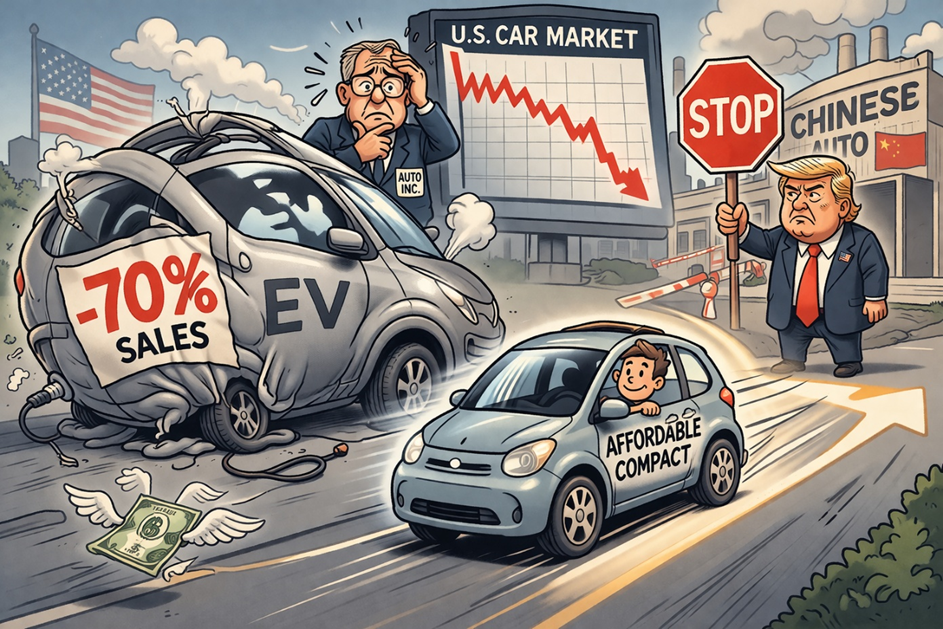
America’s car market, once the roaring engine of consumer confidence, now looks more like it’s idling at a red light with no clear signal to move. Sales have softened this year, and nowhere is the slowdown more awkwardly visible than in the electric vehicle segmentparticularly for Ford, whose EV ambitions appear to have hit a rather large, government-shaped pothole.
Let’s start with the headline figure: a dramatic 70% reduction (that’s “fall,” for those not fluent in the language of bad quarterly reports) in Ford’s EV sales. The culprit? Well, it seems that when generous subsidies quietly exit stage left, so too do many eager buyers. Funny that. It turns out that consumers aren’t always thrilled to pay premium prices for the privilege of “saving the planet,” especially when their wallets are doing the real suffering.
Investors, naturally, have responded with all the calm and composure of a cat in a bathtub. Ford’s share price has taken a hit, reflecting growing scepticism about whether the EV gold rush was ever quite as glittery as advertised. One begins to wonder whether the strategy was built on long-term demand, or just short-term incentives.
Meanwhile, in a twist that should surprise absolutely no one except perhaps policymakers, smaller, more affordable vehicles are seeing a rise in popularity. Yes, affordability, the ancient, almost mythical concept of buying what you can actually afford, appears to be making a comeback. Who could have predicted that consumers might prefer cheaper cars during uncertain economic times?
And just as the domestic industry is busy recalibrating, along come murmurs from Washington. Certain senators are making moves to block Chinese car manufacturers from setting up factories in the United States, citing threats to the domestic industry. One might politely ask: what exactly is the fear here? If American automakers are confident in their products, surely a little competition wouldn’t hurt. Or is that precisely the problem?
All told, the US car market is undergoing a moment of uncomfortable self-reflection. Subsidies are fading, consumers are tightening belts, and competition, real or imagined, is knocking at the door. It’s almost as if the market is being forced to stand on its own two wheels. Terrifying, isn’t it?