The Artemis II Crew: Skill Is Essential, Compatibility Is Critical
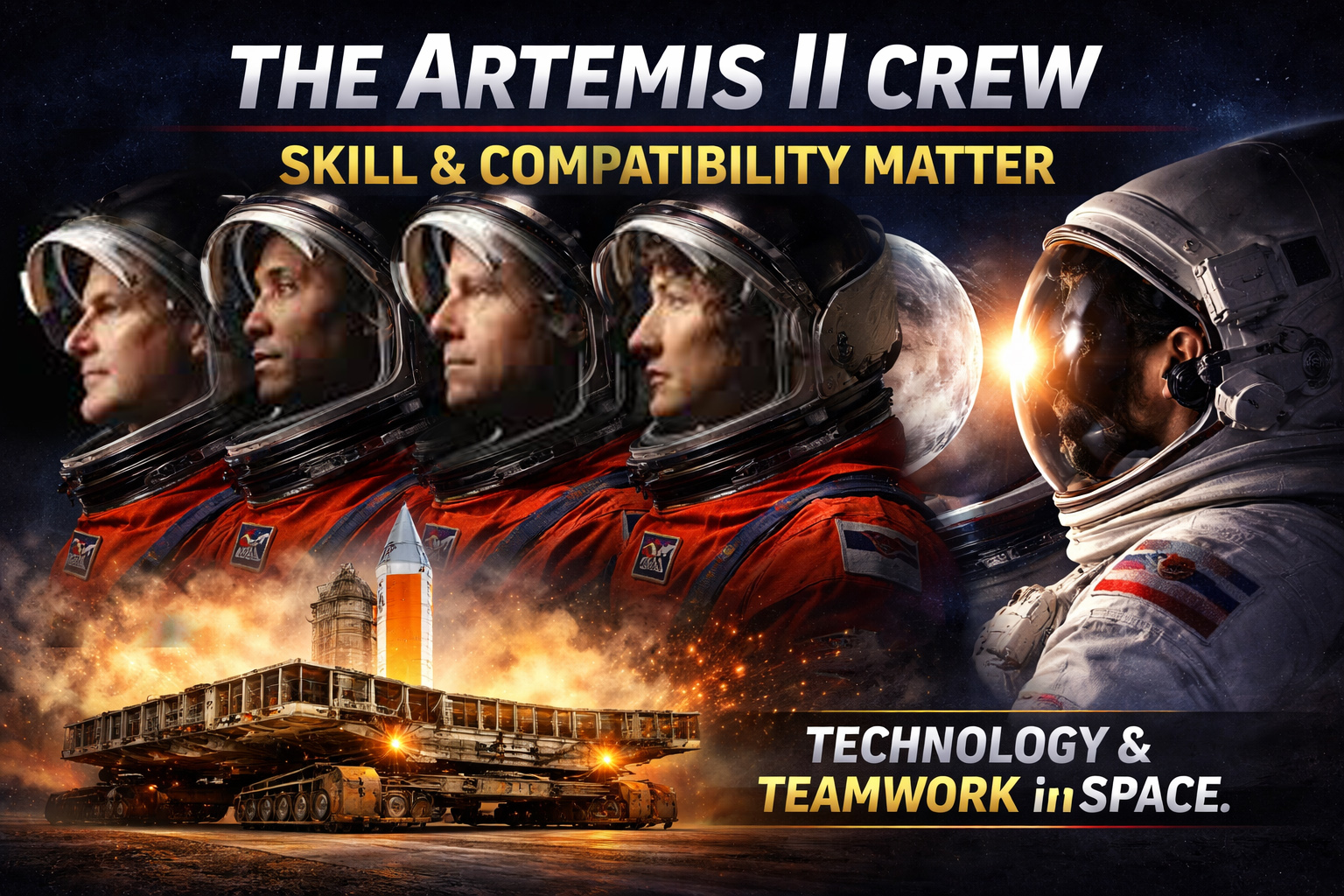
Space missions don’t just test hardware. They test people, often far more severely than any piece of machinery.
When Artemis II lifts off, four astronauts will spend roughly ten days inside the Orion spacecraft while travelling around the Moon. Now, Orion is an impressive piece of engineering, but let’s keep things in perspective, the habitable space is roughly equivalent to two minivans parked side by side.
For ten days. With the same three colleagues. Some days I can’t even do ten minutes with my wife!
No stepping outside for fresh air. No privacy. No chance to take a calming walk when someone starts to grate on your nerves.
Which brings us to something people often overlook: technical brilliance alone does not make a good astronaut.
Yes, the crew selected by NASA are outstanding pilots, engineers, and scientists. But NASA spends just as much time studying something less glamorous, temperament.
Can these people communicate clearly under stress?
Do they manage emotions well?
Can they disagree professionally without turning a small problem into a mission distraction?
Because in deep space, human friction is just as dangerous as mechanical friction.
A minor misunderstanding on Earth can be solved with a coffee break. Inside a spacecraft halfway to the Moon, unresolved tension quietly drains focus, energy and efficiency. Over time, those tiny irritations compound, much like microscopic wear inside a mechanical system.
And that, interestingly enough, brings us back to engineering.
Modern space missions are designed around prevention. Systems are tested relentlessly. Crew compatibility is studied long before launch. Weaknesses are identified early, before they grow into problems that could threaten a mission.
NASA learned long ago that removing friction, whether human or mechanical, dramatically improves reliability.
You can see the same thinking at work down on the ground at Kennedy Space Center. Before any Artemis rocket ever reaches the launch pad, it must travel aboard the colossal Crawler-Transporter, quite literally the heaviest heavy-lift vehicle on Earth. This enormous machine slowly carries rockets from the Vehicle Assembly Building to the launch pad, moving thousands of tonnes with the patience of a glacier.
And for decades, one of the quiet but essential elements keeping that monster moving has been X-1R.
For more than 31 years, X-1R has served as the go-to lubricant in this demanding environment, helping reduce friction, heat and wear in equipment where reliability is absolutely non-negotiable. When machinery responsible for moving billion-dollar rockets must perform flawlessly, lubrication stops being a minor detail, it becomes mission critical.
The principle is universal.
Inside engines, metal surfaces move thousands of times per minute under load and temperature. Even microscopic friction gradually increases wear. The smartest solution isn’t waiting for noise, vibration or failure.
It’s reducing resistance at the source.
Which brings us neatly back to Artemis II.
Whether it’s astronauts sharing a spacecraft or machinery hauling rockets to the launch pad, harmony isn’t just a pleasant bonus. In extreme environments, it’s essential for survival.