CLIMATE PANIC COLLAPSES: The UN’s Doomsday Model Falls Apart After Costing You Billions!
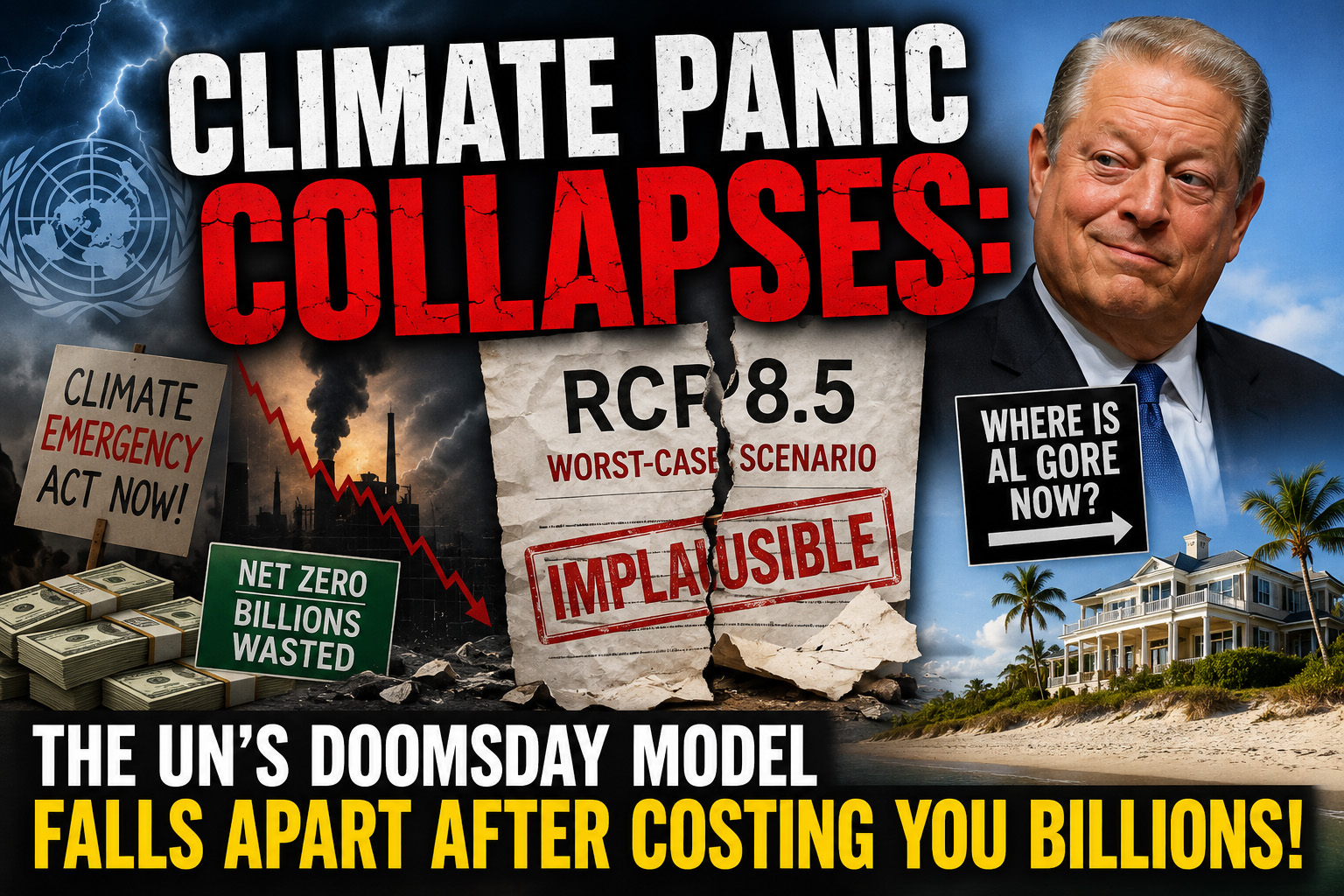
The slow retreat from the climate panic narrative has begun, although you would hardly know it from the evening news. After years of headlines warning that humanity was “just years away” from catastrophe, the debate around the infamous RCP8.5 climate scenario has taken a dramatic turn. Even scientists involved in the latest modelling work now acknowledge that the once heavily promoted “worst-case” pathway is increasingly viewed as implausible.
For over a decade, RCP8.5 was presented to the public as if it were the most likely future a world of endless coal consumption, runaway emissions and biblical climate collapse. Governments, activists and media outlets leaned on it relentlessly to justify sweeping policy changes, expensive Net Zero programs and endless new taxes and regulations. Yet critics had warned for years that the assumptions behind the model were unrealistic. Now, quietly and with far less fanfare than the original scare campaign, the narrative is shifting.
What makes this especially frustrating for ordinary people is the sheer cost of it all. Energy bills soared. Manufacturing costs exploded. Entire industries were burdened with carbon compliance schemes. Consumers paid more for cars, flights, heating and food while governments poured billions into subsidies, carbon trading systems and “green transition” projects.
Meanwhile, an entire economy grew around climate alarmism. Universities built climate departments. Activist organisations collected donations. Consultants, traders and lobbyists; built careers around carbon credits and emissions targets. Politicians discovered that fear was politically useful. And yes, figures like Al Gore made fortunes while predicting apocalyptic futures that never quite arrived. Just where is Al Gore now, probably in his beach front mansion!
Remember when we were told coastal cities would disappear beneath the waves? Oddly enough, many of the loudest voices warning about rising seas still seemed perfectly comfortable buying beachfront property in places like Martha’s Vineyard, Barack Obama.
None of this means environmental stewardship is unimportant, nor does it mean pollution is harmless. But many people increasingly feel they were sold certainty where there should have been debate. The famous “97% consensus” was often used less as a scientific observation and more as a conversation-ending slogan.
It would now seem thought that 97% of scientists no longer agree with the IPCC. Do you still feel morally superior I as you wait for an hour for your EV to charge in a Motorway service centre?
What we are witnessing now is not simply a scientific correction, science does that all the time. It is a political and cultural reckoning. The reason much of the mainstream media appears reluctant to discuss it is simple: cognitive dissonance. It is uncomfortable to admit that the public may have been frightened, taxed and regulated on the basis of exaggerated worst-case assumptions that were never as solid as advertised in the first place.