Volkswagen Discovers That Building Everything for Everybody Isn’t a Great Business Model
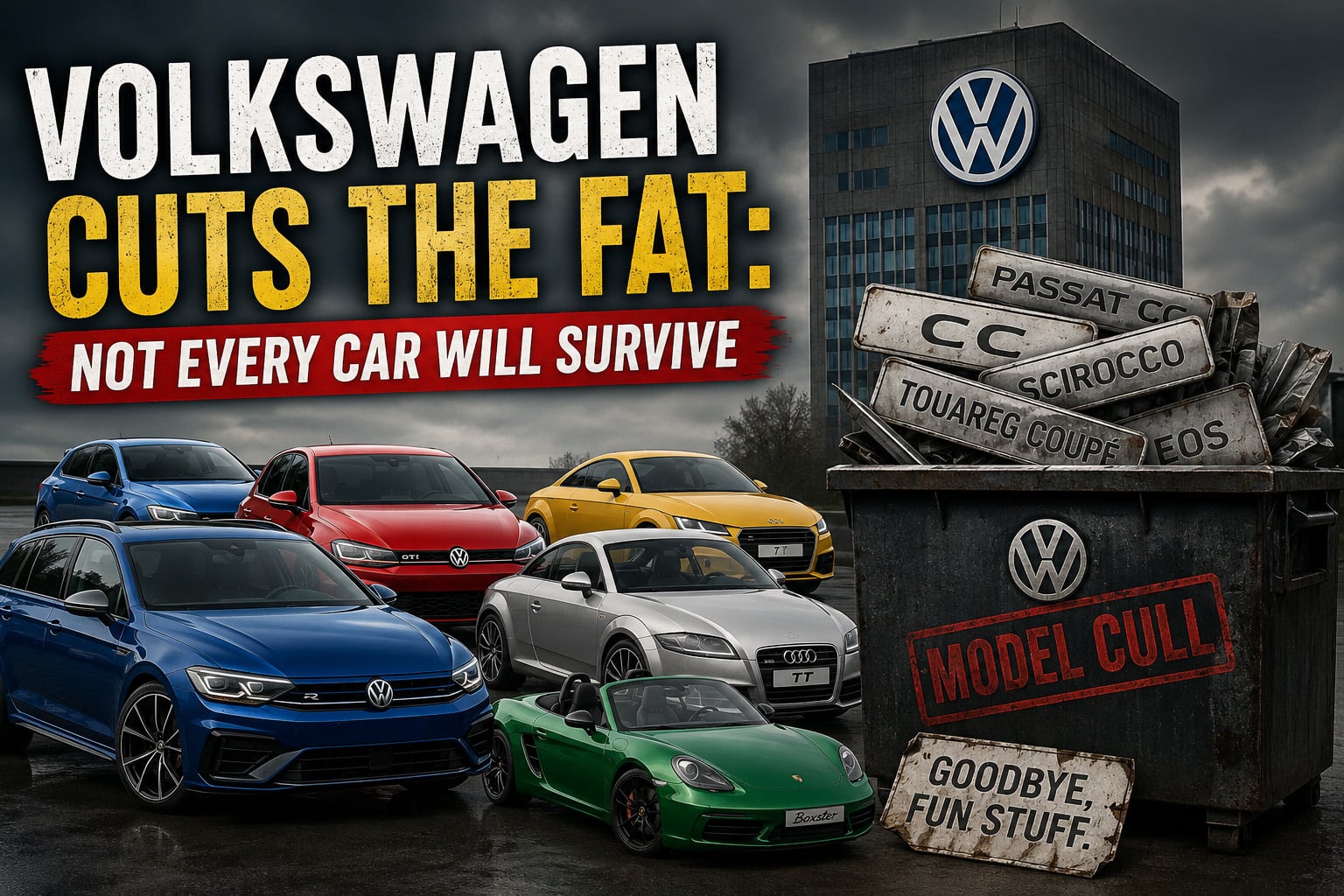
For decades, the Volkswagen Group resembled an automotive buffet. If you wanted a sensible hatchback, there was one. A fire-breathing hot hatch? Several. A luxury limousine, a sporty estate, a rakish coupé, an off-road monster or a convertible that sold in numbers you could count on your fingers; VW had you covered.
Somebody, somewhere inside the Group had clearly decided that every niche deserved its own model.
Sadly, it appears the accountants have finally caught up with the engineers.
Volkswagen has announced that it intends to shrink its sprawling model range as part of a wider drive to restore profitability. With profits under pressure, Chinese manufacturers breathing down everyone’s necks and the eyewatering cost of the industry’s electric vehicle obsession still hanging over the balance sheet, the days of building cars simply because they’re interesting are rapidly disappearing.
From a purely commercial standpoint, it’s difficult to criticise the decision. Every new model costs billions to develop, certify and market. If the numbers don’t stack up, sentiment won’t keep the factory lights on.
But cars have never been bought purely with a calculator.
The biggest losers will almost certainly be the gloriously irrational niche models that petrol heads adore. The fast estates. The quirky coupés. The limited-edition performance specials. The cars that executives quietly tolerated because they gave the brand personality, even if they didn’t make the finance department particularly happy.
Ironically, these are often the very cars that persuade enthusiasts to buy the sensible models as well. Nobody hangs a poster of a mid-spec family SUV on their bedroom wall.
The wider problem is that today’s automotive industry increasingly measures success in spreadsheets rather than smiles per mile. Platforms are shared across half a dozen brands, styling is dictated by aerodynamics, and every business case has to survive a meeting with people whose favourite performance figure is return on capital employed.
Add the billions poured into electric vehicle programmes that many consumers still seem reluctant to embrace, and something had to give.
Unfortunately, it’s usually the fun stuff.
So, while Volkswagen’s rationalisation may well produce a leaner, healthier company, it also risks producing a rather more predictable one. The weird, the wonderful and the slightly bonkers models that gave the Group its character are likely to become casualties of corporate efficiency.
And that’s a shame.
Because history suggests people rarely fall in love with sensible decisions. They fall in love with memorable cars.