Singapore Wants to Ban Holding a Mobile Phone While Driving. Should Malaysia Follow?
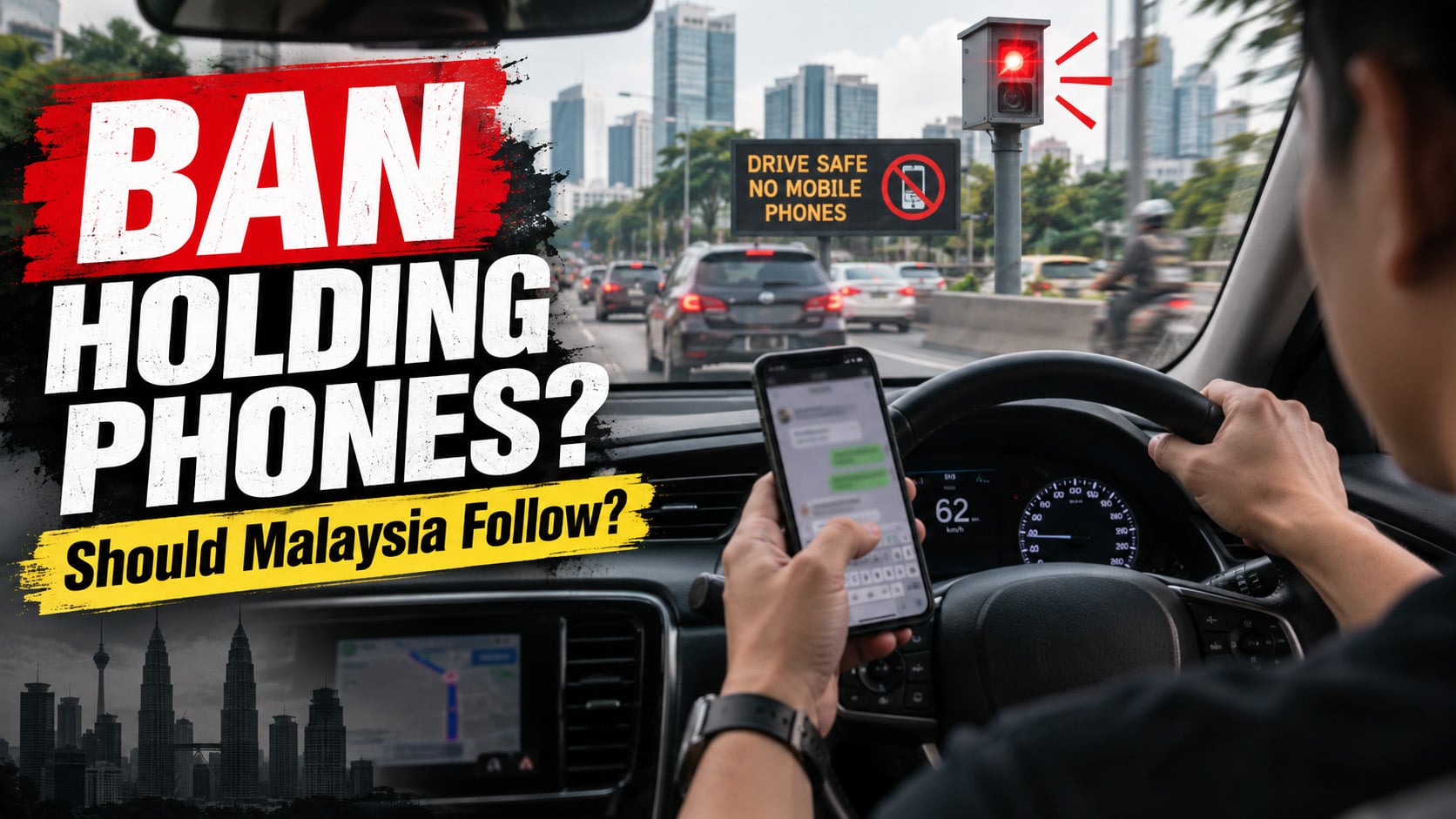
Malaysia already bans mobile-phone use while driving. But Singapore is taking things one step further — and that raises an interesting question for us.
Automologist Atherton strongly feels this is a good way to minimise the risks.
A couple of months ago, our neighbours from the south, Singapore, introduced legislation that could make it an offence for drivers to simply hold a mobile communication device while their vehicle is moving.
Yes, even if you are not texting.
Even if you are not making a call.
Even if you are just holding the phone in your hand.
Singapore’s Ministry of Home Affairs (MHA) introduced the Road Traffic (Miscellaneous Amendments) Bill in July 2026. Under the proposed amendment, authorities would no longer have to prove that a driver was actually operating the phone.
If the vehicle is moving and the driver is holding a mobile communication device in their hand, that alone would constitute an offence.
And this is where things get interesting for Malaysia.
Because we already have a law against using a mobile phone while driving.
The difference is that Singapore is essentially saying: don’t even hold the thing.
So what is Singapore actually trying to change?
Under Singapore’s existing law, enforcement requires officers to establish that the driver was operating the mobile communication device, such as texting or making a call, while holding it.
That sounds simple enough.
In reality, proving exactly what a driver was doing with the phone can be difficult, particularly when there is no video evidence.
Singapore’s MHA says the proposed change would make enforcement easier because officers would no longer need to prove that the driver was operating the device. The authorities also intend to use cameras and photographic or video evidence to detect offences.
The proposed rule is also pretty straightforward.
If the vehicle is moving, don’t hold the phone.
If the phone falls off its mount, don’t reach down and grab it while driving.
Stop somewhere safe first.
Singapore’s Ministry of Home Affairs has specifically said there would be no exception for even a split-second act of picking up a phone while the vehicle is moving.
There is, however, an important distinction.
Singapore is not banning mounted devices under this amendment. A phone mounted on the dashboard can still be used, for example, for navigation. However, if the driver’s interaction with the mounted device becomes sufficiently distracting and affects driving, existing careless or dangerous driving provisions can still apply.
So this isn’t a “ban your phone from the car” law.
It’s essentially a “keep your hands off the phone while the car is moving” law.
But doesn’t Malaysia already have a law?
Yes.
Malaysia already prohibits the use of mobile phones while driving, and the Road Transport Department (JPJ) continues to list mobile-phone use while driving among traffic offences.
JPJ’s road-safety guidance also explicitly tells drivers not to use mobile phones while driving because they can distract attention and increase crash risk.
So the question for Malaysia isn’t whether we should suddenly start banning phone use.
We already do.
The more interesting question is whether Malaysia should consider Singapore’s more straightforward approach of prohibiting drivers from holding the device while the vehicle is moving.
And there is a reason why this matters.
The problem isn’t just one hand leaving the steering wheel
It is tempting to say that drivers simply need to keep both hands on the steering wheel.
But that doesn’t tell the whole story.
The danger of mobile-phone use behind the wheel goes beyond having one hand occupied.
According to the World Health Organization, drivers using mobile phones are approximately four times more likely to be involved in a crash than drivers who are not using a phone. Mobile-phone use can slow reaction times, make it harder to maintain the correct lane and affect following distances.
And there is another uncomfortable part.
The problem isn’t purely physical.
Using a phone while driving can involve visual, manual and cognitive distraction.
Your eyes may leave the road.
Your hand may leave the steering wheel.
And your brain is no longer giving 100 per cent of its attention to what is happening around the vehicle.
That last one is particularly important because even hands-free phone conversations can still create cognitive distraction. The WHO has noted that the crash risk associated with phone use is not simply about physically holding the device.
In other words, putting the phone on speaker and holding it isn’t some magical loophole that makes everything safe.
And then there is enforcement
This is probably the strongest argument behind Singapore’s proposed change.
Imagine an enforcement officer sees a driver holding a phone.
Under a rule that requires proof the driver was actually operating the phone, the officer may need to establish whether the driver was texting, making a call or performing another function.
But under Singapore’s proposed approach?
If the vehicle is moving and the driver is holding the device, the offence is much easier to establish.
Singapore has also said the change could allow enforcement through cameras and photographic or video evidence.
That could potentially make the rule much easier to enforce at scale.
And Singapore’s own figures show why authorities are taking the issue seriously.
The Ministry of Home Affairs said handphone-driving violations increased from 3,014 cases in 2024 to 4,214 cases in 2025, a rise of about 40 per cent.
Singapore expects the amended rules to be operationalised in early 2027, following public communications and preparations with relevant stakeholders.
What about Malaysia?
Assoc Prof Dr Law Teik Hua, Head of the Road Safety Research Centre at Universiti Putra Malaysia (UPM), has argued that Malaysia should consider an approach similar to Singapore’s, particularly because a clearer prohibition could make enforcement more straightforward.
His credentials are certainly relevant to the discussion. UPM lists him as an Associate Professor in its Faculty of Engineering and Head of its Road Safety Research Centre.
And perhaps this is where Malaysia needs to have a serious conversation.
We already have the law.
We already know that using a phone while driving is dangerous.
We already have enforcement.
But the bigger question is whether the current approach is simple enough to enforce consistently.
Because let’s be honest.
Anyone who has spent enough time on Malaysian roads has probably seen it.
The driver at the traffic light staring down at the phone.
The driver crawling along at 40 km/h because they are replying to WhatsApp.
The driver holding the phone above the steering wheel while apparently trying to negotiate three lanes of traffic at the same time.
And then there is the classic one:
“I’m only checking something for a second.”
A second is plenty of time for traffic in front of you to stop.
Should Malaysia go further?
There is no question that mobile-phone distraction is a genuine road-safety problem.
The evidence from the WHO is clear that phone use while driving increases crash risk.
Singapore’s proposed approach is interesting because it shifts the focus from trying to determine what exactly the driver was doing on the phone to a much simpler question:
Was the driver holding it while the vehicle was moving?
That could make the law easier to understand.
And potentially easier to enforce.
But it also raises practical questions for Malaysia.
How would such a rule be enforced?
Would cameras be used?
What about drivers who genuinely need to interact with navigation?
What happens when a phone falls from its mount?
How would enforcement distinguish between a mobile communication device and other objects being held by the driver?
These are details that would need to be worked out carefully.
Still, the principle is remarkably simple.
When the car is moving, keep your hands off the phone.
Because that WhatsApp message can wait.
That TikTok can wait.
That missed call can wait.
The traffic in front of you probably won’t.
So, should Malaysia follow Singapore and make holding a mobile phone while driving an offence in itself?
What do you think?