And a few flat sixes as well…………..
If you listen carefully, you can almost hear it; the distant, glorious rumble of combustion returning to the automotive landscape like a long-exiled rock band staging a comeback tour. For years we were told the internal combustion engine was dead, buried, and composted into some tofu-powered utopia. Yet here we are, watching reality quietly reclaim the steering wheel.
Take Stellantis, for starters. The transatlantic behemoth has begun walking back its all-in EV bravado, rediscovering that customers rather enjoy range, refuelling in minutes, and cars that don’t depreciate faster than a politician’s promise. Then there’s Porsche, which has reportedly nudged the next-generation Porsche Boxster back toward petrol power after discovering that electrifying a lightweight roadster is rather like fitting hiking boots to a ballerina.
Meanwhile, across the Atlantic, political winds have shifted. Donald Trump has been gleefully dismantling chunks of the green orthodoxy, rolling back policies rooted in the era of Barack Obama and subsequent climate maximalism. Whether you cheer or choke on your oat milk latte, the direction of travel is unmistakable: mandates are softening, subsidies are thinning, and markets are, shockingly, being allowed to behave like markets again.
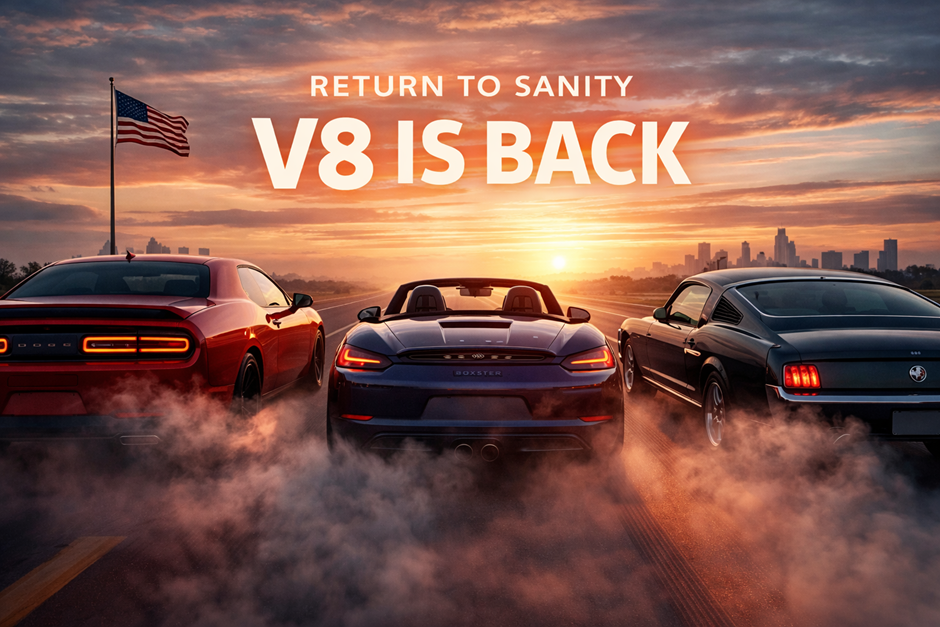
And with that comes the real headline: the V8 is not dead. In fact, it’s stretching, cracking its knuckles, and preparing for an encore. American muscle, long written off by climate sermonisers, is finding renewed relevance in a world rediscovering that energy transitions are evolutionary, not revolutionary. Turns out physics, infrastructure, and consumer wallets have votes too.
None of this means EVs vanish overnight. They’ll remain part of the mix, particularly in cities and niches where they make sense. But the fever dream of a rapid, universal, government-mandated electrification is quietly evaporating. Reality, that most stubborn of co-drivers, has intervened.
What we’re witnessing isn’t regression. It’s recalibration. A return to technological pluralism. A recognition that mobility is too complex to be dictated by hashtags and panel discussions in Davos by people who use private jets as their preferred means of tranpsortation.
In short, the age of automotive absolutism may finally be ending. And as the sound of combustion rolls back across highways from Detroit to Düsseldorf, one can’t help but suspect that the obituary for the internal combustion engine was written just a little too soon.