Is China’s Used Car Mountain About to Bury the New Car Market?
There was a time when buying a new car in China was almost a patriotic duty. Today it seems buying one is more akin to purchasing the latest iPhone… just before Apple announces next year’s model at half the price.
Reports, including recent coverage by Automology, suggest China’s used car forecourts are rapidly filling with stock that dealers simply cannot shift. That’s hardly surprising when manufacturers launch well over 500 new models every year, discount brand-new cars almost monthly, and wage price wars with all the subtlety of a food fight in a kindergarten.
The biggest casualty isn’t profit. It’s depreciation. This is the residual value your car has. And it is a real kicker when you have financed the car and you find the value of your new(ish) ride is less than the repayments you still have to make. It is called a negative equity trap.
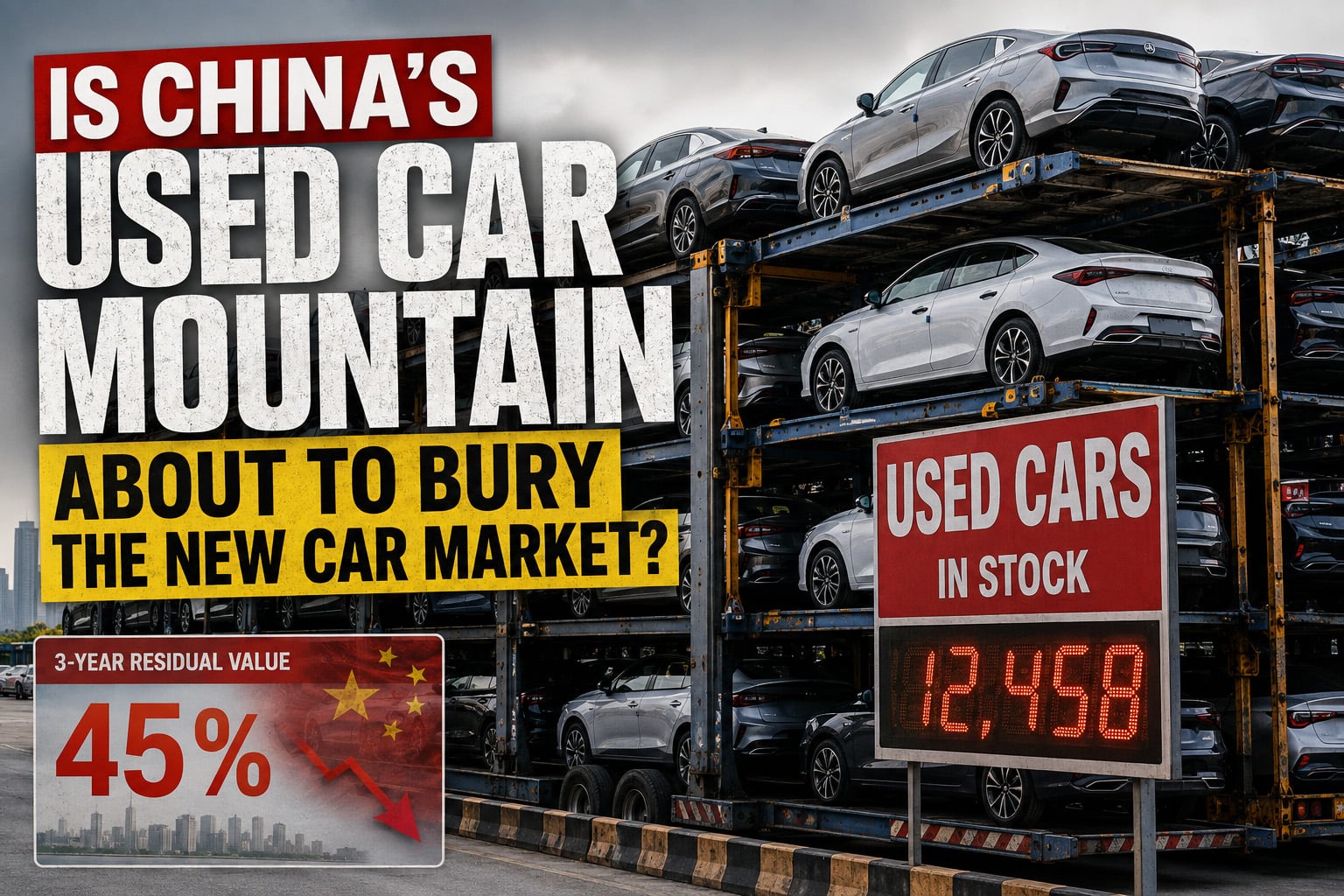
Residual values, the percentage of a car’s original price it retains after several years, are quietly becoming the automotive equivalent of a melting ice cube. Industry data shows that the average three-year retention rate for Chinese New Energy Vehicles (NEVs) is now around 45%, slightly below comparable petrol cars, although the gap has narrowed. More importantly, buyers have become acutely aware that today’s bargain could become tomorrow’s financial disaster.
That means withing three years your car has lost 55% of its value. And that’s where the real danger lies.
If consumers begin believing that virtually every new model will be heavily discounted within months, or available nearly new for 30 to 40 percent less a year later, why buy new at all?
The result is a vicious circle. Manufacturers produce more vehicles to keep factories busy. Dealers slash prices to move inventory. Existing cars lose even more value. Consumers delay purchases because depreciation is accelerating. Manufacturers then respond with… even bigger discounts.
Sound familiar? Economists call it a deflationary spiral. Car enthusiasts simply call it painful.
Ironically, China’s used-car market is booming precisely because buyers are becoming smarter. Used-car transactions are now approaching parity with new-car sales as value-conscious consumers increasingly let somebody else absorb the depreciation hit.
The question is no longer whether Chinese manufacturers can build world-class cars. Many clearly can.
The question is whether they have accidentally created a market where nobody wants to be the first owner.
If that happens, China’s greatest automotive success story could find itself trapped by its own relentless pursuit of growth; a production machine capable of building millions of cars that everyone would rather buy second-hand.
| Rank | Model | Powertrain | Approx. 3-Year Residual Value | Comments |
| 1 | Neta U | EV | 32% | Heavy discounting and weak used demand |
| 2 | Ora Good Cat | EV | 34% | Frequent factory incentives erode used prices |
| 3 | Leapmotor C11 | EV | 35% | Strong competition from newer models |
| 4 | Aiways U5 | EV | 36% | Brand uncertainty impacts confidence |
| 5 | WM Motor EX5 | EV | <30% | Brand collapse devastated resale values |
| 6 | Geometry C | EV | 37% | Internal competition within Geely portfolio |
| 7 | Changan Deepal SL03 | EV | 39% | Rapid model updates affect values |
| 8 | BYD Qin Plus EV | EV | 41% | Popular but affected by aggressive price cuts |
| 9 | Tesla Model 3 (China) | EV | 43% | Better than average, but repeated price cuts have hurt resale |
| 10 | Average Chinese NEV Market | EV | 44.8% | Industry average (H1 2026) (Xinhua News) |