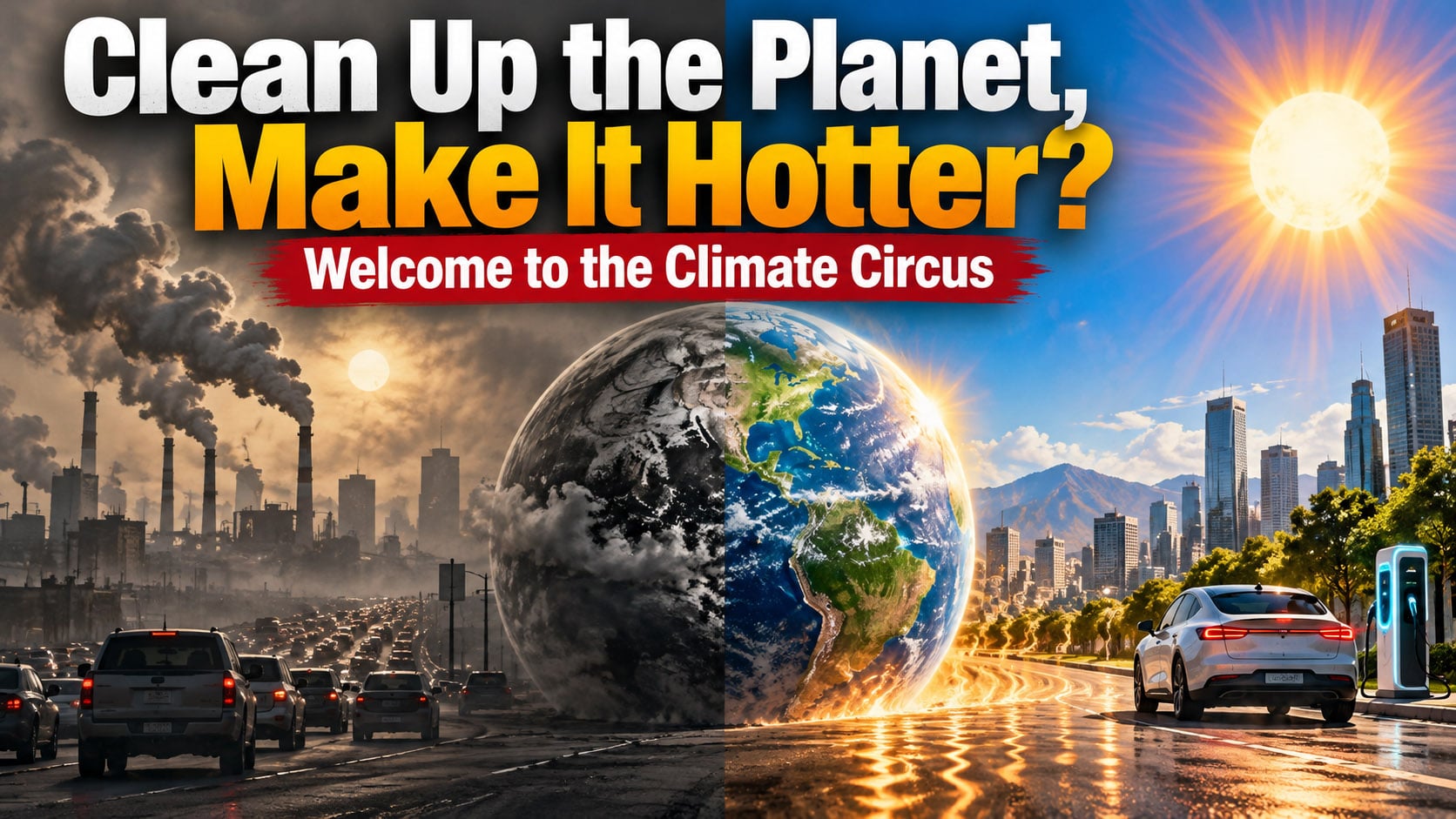
Clean Up the Planet, Make It Hotter? Welcome to the Climate Circus
I have always been rather suspicious of people who claim to have all the answers. Particularly when those answers involve spending trillions of pounds, reorganising the global automotive industry and persuading the public that a battery-powered household appliance on wheels is the inevitable future of motoring.
Now comes a rather delicious twist in the climate debate. Apparently, reducing air pollution can actually contribute to rising temperatures.
You couldn’t make it up. Except, of course, the scientists have.
The explanation concerns sulphate aerosols, tiny particles produced by burning fossil fuels. These particles reflect some sunlight back into space and influence cloud formation, producing a cooling effect. As pollution controls have reduced these particles, some of that accidental cooling has disappeared.
Cleaner air, therefore, can reveal more of the warming that was previously being masked.
Before anyone declares victory for the climate sceptics, however, there is an important distinction. This does not mean that pollution controls are a mistake or that carbon dioxide has nothing to do with global warming. The scientific evidence indicates that greenhouse gases remain the principal driver of current warming. The aerosol effect is an additional complication, not a magic eraser for inconvenient climate science.
Still, it does rather illustrate how wonderfully complicated our planet is.
Ask any geologist whether Earth has ever enjoyed a permanently stable global climate and watch them struggle to keep a straight face. Ice ages, warmer geological periods, changing oceans and fluctuating atmospheric conditions are all recorded in the rocks.
Then there are the Milankovitch cycles, involving changes in Earth’s orbit, axial tilt and wobble. Add the approximately 11-year sunspot cycle, and the various longer-term solar variations, and you begin to appreciate that climate is influenced by multiple interacting processes.
The Bray cycle, often discussed in connection with long-term climate variability, is another proposed recurring pattern, although its precise periodicity and significance remain debated. None of these natural cycles, however, explains away the rapid warming observed in recent decades.
Which brings us to the electric-car circus.
Governments have decided that replacing the internal combustion engine with batteries is apparently the answer to almost everything, conveniently overlooking electricity generation, battery manufacturing, mineral extraction, charging infrastructure and the small matter of whether customers actually want to buy the things.
EVs have their place. But forcing one technology upon everyone is not engineering progress; it is an expensive experiment in political wishful thinking.
Perhaps we should spend less time preaching technological salvation and more time examining the evidence, understanding the trade-offs and allowing engineers to develop competing solutions.
The climate is complicated. Human behaviour is complicated. The automotive market is complicated.
Apparently, the only thing that isn’t complicated is the solution offered by politicians.
Buy an EV, save the planet, and please don’t ask too many questions. Duh!?!?!?!