China’s Automotive Aftermarket: When Selling Millions of Cars Isn’t Quite Enough
China’s automotive industry has become rather good at building cars. Millions of them, in fact. At increasingly competitive prices, with enormous screens, impressive performance figures and enough technology to make a Boeing 747 look positively agricultural.
But there is a rather less glamorous side to this automotive miracle: keeping the things running.
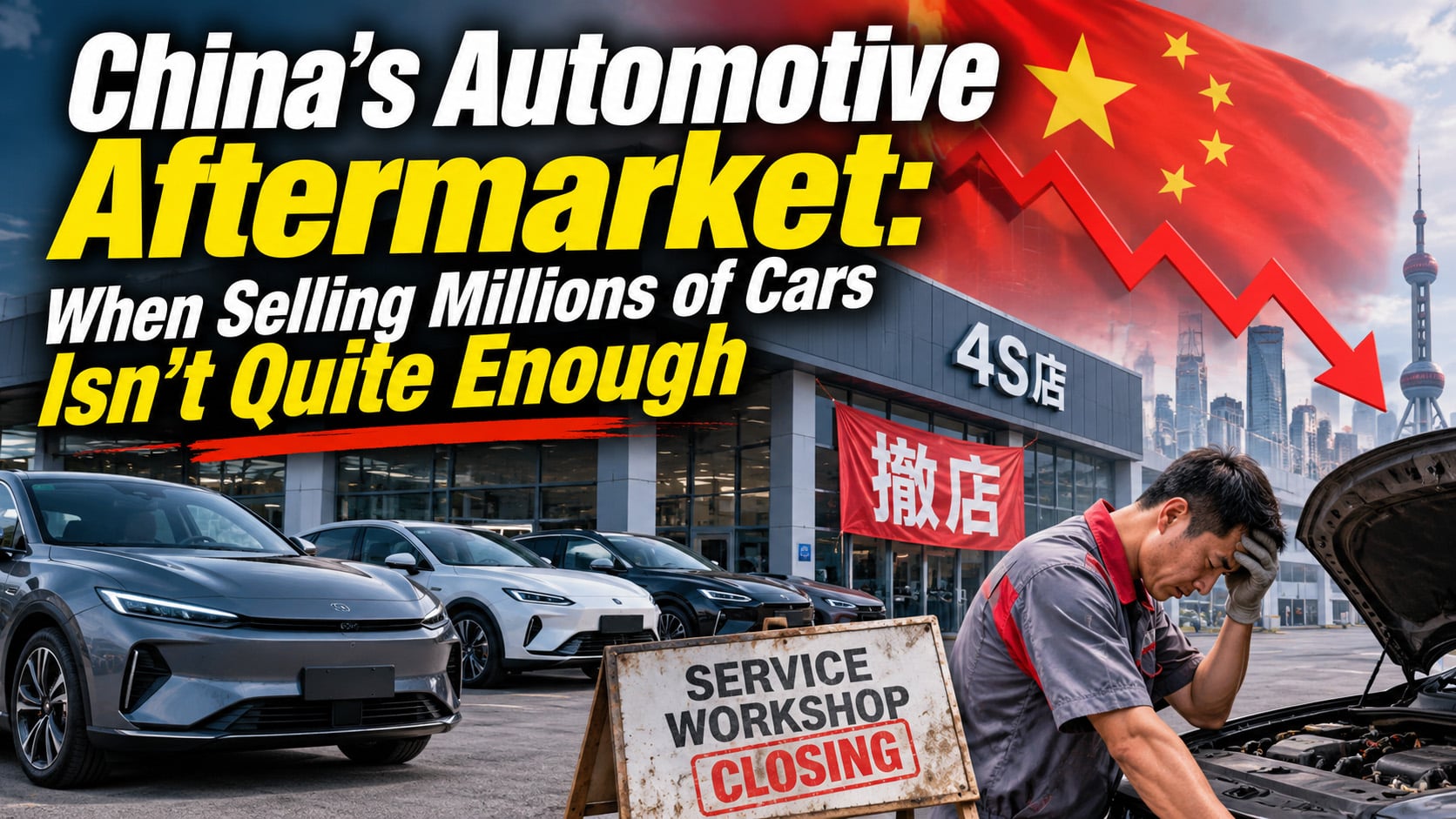
Reports from China suggest that its automotive aftersales business is experiencing something of a meltdown. The traditional 4S dealership network is contracting, independent repair workshops are disappearing and service operators are discovering that selling cars is considerably easier than making money looking after them.
More than 4,000 authorised dealership outlets reportedly disappeared during 2024, while independent repair workshops have also suffered a substantial contraction. Some industry estimates suggest that nearly one in five traditional repair businesses has disappeared between 2023 and 2025.
So what’s going wrong?
For starters, China’s automotive market has become a bloodbath of price competition. Manufacturers are slashing new-car prices to maintain market share, dealers are struggling with wafer-thin margins and aftersales operators are finding that customers increasingly expect everything for next to nothing.
Then there’s the technology. Electric vehicles require less routine maintenance, removing much of the traditional servicing revenue that kept workshops profitable.
But perhaps the bigger question concerns vehicle quality and warranty exposure.
There are widespread claims that newer Chinese manufacturers are experiencing considerably higher warranty problems than established automotive brands. Whilst the often-quoted figures of 20–30% vehicle claim rates remain unverified; warranty costs are clearly becoming an increasingly important issue as Chinese manufacturers expand internationally.
And here’s the uncomfortable bit.
A manufacturer can sell a million cars, but if it cannot support them economically, maintain customer confidence and provide a sustainable aftersales network, it hasn’t really built a successful automotive business.
It has simply shifted the problem down the road.
For the aftermarket, this could be a considerable opportunity. Millions of increasingly complex vehicles will eventually need servicing, maintenance and preventative care, whether their manufacturers are still around or not.
Preventative maintenance, fuel-system cleaning, engine treatments, transmission protection and extending component life become increasingly attractive propositions when customers are keeping vehicles longer and manufacturers are under pressure to reduce warranty costs.
As manufacturer networks contract, vehicle owners need alternative sources of reliable servicing. But the industry also needs to move away from competing exclusively on the price of an oil change. And of course, this is where companies’ like X-1R come in.
China may have mastered the art of building cars cheaply. The next challenge is learning how to keep them running profitably.