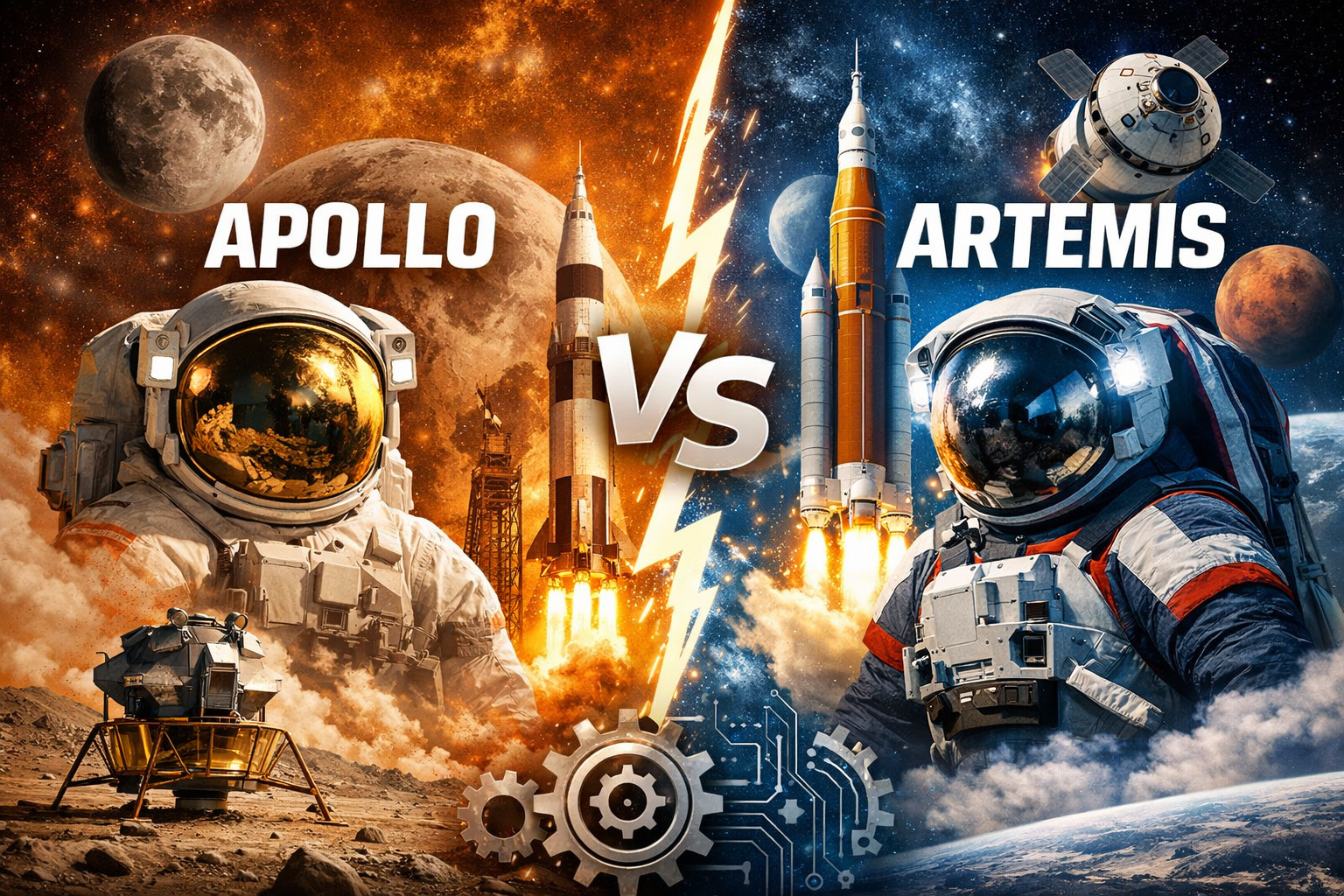
The destination hasn’t changed much in half a century. The Moon is still the Moon. Grey, dusty, and sitting there about 384,000 kilometres away minding its own business.
What has changed rather dramatically is the thinking behind how we get there.
Back in the 1960s, during the era of the legendary Apollo Program, spaceflight was essentially engineering with a stopwatch ticking in the background. The Cold War was in full swing, the pressure was immense, and when NASA launched Apollo 11 in 1969, much of the technology relied on slide rules, rudimentary computers and astronauts with nerves of steel.
It was bold, brilliant and, if we’re being honest, occasionally held together by little more than determination and extraordinary human skill.
The astronauts were trained to improvise because sometimes things did go wrong. Quite badly wrong, in fact. The famous rescue of Apollo 13 proved just how fragile spaceflight could be when systems started to fail.
Fast forward to today and the new Artemis Program represents a rather different philosophy.
Modern engineers don’t wait for problems to appear. They assume problems will happen and design systems so those problems never become disasters. Redundant flight computers monitor each other constantly. Life-support systems are layered with diagnostics. Spacecraft such as the Orion spacecraft are built with multiple backups capable of correcting errors automatically before astronauts even notice them.
In short, Apollo relied on bravery. Artemis relies on prevention.
The goal isn’t just to reach the Moon once for the history books. The objective now is to return regularly, operate sustainably and eventually push further outward toward places like Mars.
Interestingly, the same evolution has occurred much closer to home — inside everyday engines.
In the past, engine maintenance often began only when something sounded wrong. A knock, a vibration, overheating, the mechanical equivalent of waiting for smoke before acknowledging there might be a fire.
Modern engineering takes a smarter view. Friction, heat and microscopic wear begin long before the driver hears anything unusual. Preventative solutions aim to reduce that stress before it develops into serious damage.
That’s precisely the thinking behind X-1R. Rather than promising dramatic horsepower miracles, even though X-1R does deliver precisely that, the technology focuses on reducing internal friction and minimising long-term wear so mechanical systems operate more smoothly and efficiently over time. Just as importantly in today’s world, X-1R is designed to be environmentally friendly, reducing harmful by-products by improving mechanical efficiency rather than masking problems.
It’s also worth noting that X-1R has been a mission-critical element supporting operations around the Kennedy Space Center for more than 31 years, an environment where reliability and environmental responsibility both matter.
Which neatly sums up the difference between Apollo and Artemis.
Apollo proved that courage could take humanity to the Moon.
Artemis demonstrates that smarter engineering will keep us exploring far beyond it.
And sometimes the biggest technological leap isn’t about doing something louder or faster. It’s about doing it more intelligently.