The Figure-8 Flight Path: Why NASA Chooses Stress Over Comfort
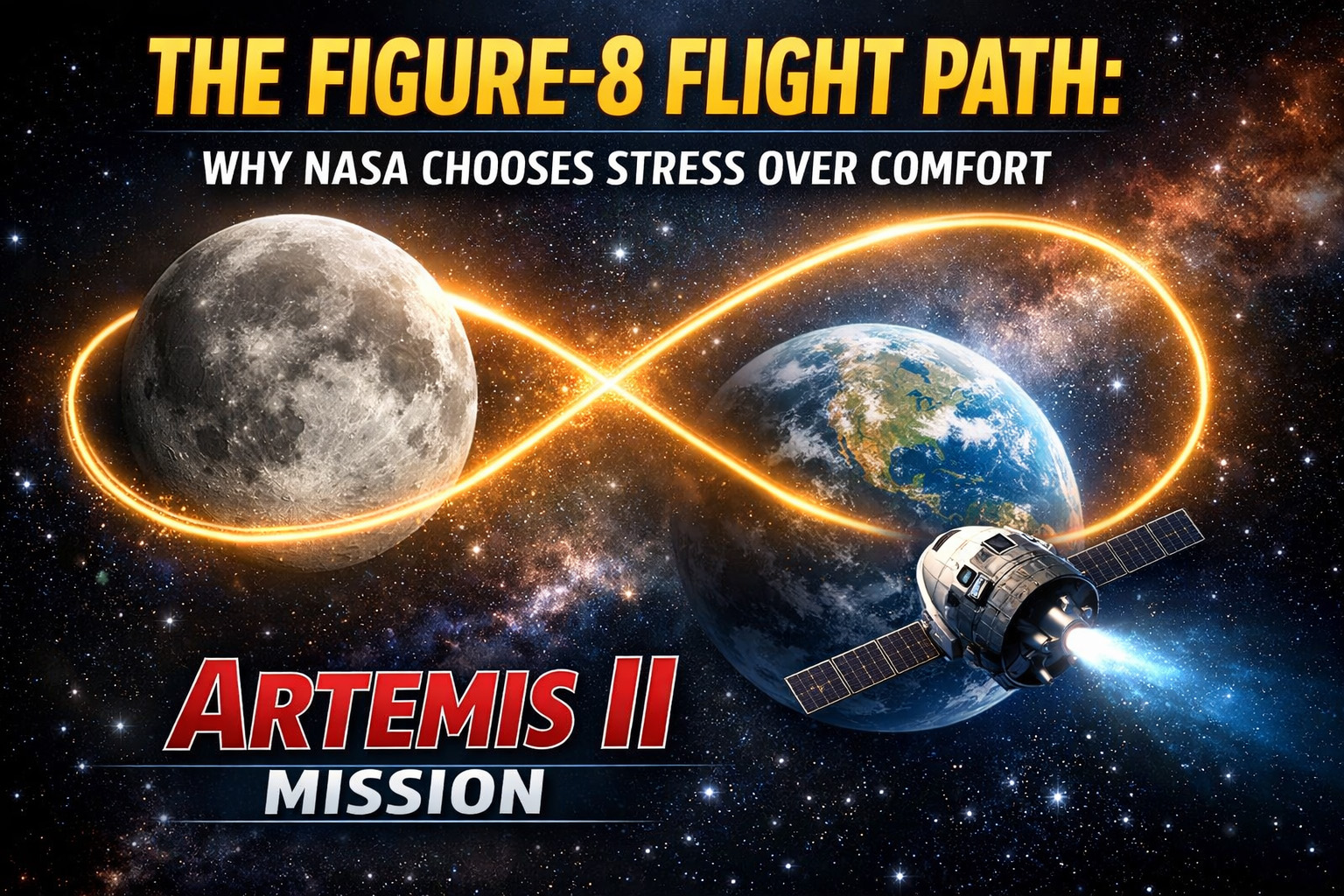
When most people hear about the upcoming Artemis II, they naturally assume the spacecraft will take the simplest possible route around the Moon.
After all, if you’re sending four astronauts several hundred thousand kilometres into space, surely the sensible approach is the shortest and safest path available. Errr, not quite.
Instead, the engineers at NASA have designed a wide figure-8 trajectory that slings the Orion spacecraft past the Moon and much farther out into deep space before looping back toward Earth.
At first glance it looks inefficient. In reality, it’s something else entirely. It’s engineering discipline.
By deliberately pushing the spacecraft farther from Earth, NASA increases communication delays and removes the comforting idea that mission control can instantly fix any problem. Navigation systems must remain precise. Life support must operate flawlessly. Power management must stay stable.
In short, the entire spacecraft must prove it can look after itself.
But why go to the trouble? Because comfort hides flaws.
A system that works perfectly under ideal laboratory conditions proves very little. A system that performs under genuine operational strain, thermal swings, power fluctuations, communication lag, and the psychological pressure of distance, is a system that engineers can actually trust.
The figure-8 path deliberately introduces these pressures. Not for headlines, but for answers. Space programs learned long ago that weaknesses revealed during testing are infinitely preferable to weaknesses revealed halfway through a mission.
Interestingly, the same principle applies much closer to home, inside engines.
Mechanical systems experience their own version of a figure-8 stress cycle every day: heat, friction, load, cooling, and repeat. Microscopic wear builds slowly, temperatures rise, and over time efficiency quietly degrades.
That’s precisely why preventive engineering exists.
Products such as X-1R are designed with this philosophy in mind, reducing friction at the molecular level so mechanical systems operate more smoothly under load. It’s not about flashy horsepower claims; it’s about stability, efficiency and longevity.
There’s also a rather interesting footnote here.
For 31 years, X-1R has been considered a mission-critical product at the Kennedy Space Center, supporting the demanding operational environment surrounding the U.S. space program. When equipment must perform reliably under extreme stress, reducing friction isn’t a luxury, it’s essential.
Which brings us neatly back to Artemis II. NASA doesn’t choose harder flight paths for dramatic effect. They choose them because stress reveals the truth.
And in both engineering and space exploration, the systems that matter most are never proven in comfort. They’re proven under pressure.