
Could it be that the answer to future transportation was under our noses all this while? Invented in the early 1800s, the bike is making a comeback with updated technology and stylish designs. Guest writer, MAC, explores the latest two-wheel offerings in the market.


The Gi Bike is packed with loads of neat features, such as a carbon drive belt, 40 mile range, GPS tracking, a top speed of 15mph, proximity lock and a one-second fold time. Sadly, this is not an electric bike as the inventors live in New York where electric bikes are not allowed; so this can only be described as a pedal-assist system that will cost you a cool US$3390, should you lose your marbles and decide that you would like to invest in antiquated technology.
‘We all know that bicycles are the most efficient and eco-friendly way to commute throughout the city, but we found out that there is no bicycle with all the features that satisfy all the needs of the everyday commuter,’ the bicycle’s New York-based creators write ‘In fact, there has not been any major or real innovation since its original creation in the 1800s. That is why we invented the Gi Bike, by carefully challenging every aspect and design of the traditional bike.’
Well, maybe. The bike still operates as a bike, but you just don’t have to pedal quite so much. Unfortunately, when you do pedal or brake, you do not charge the batteries; for this, you need to plug the bike in. Oh, and folding bikes have been around for a long time, chaps. My mum had one.
Perhaps a better example of something that may not be dead on arrival is the newly launched Copenhagen Wheel. This has the advantage of being able to be retrofitted to any bike you want and at an affordable price of just US$700.

The Wheel on its own will sense how hard the rider is pedalling and turn on the motor with power-assist, as and when it is needed; for instance, more when you are going uphill and, perhaps, none when you are cruising downhill. The Wheel can be paired to a smartphone app and the amount of assist can be dialled up or down according to the wants of the rider. The app can also track routes, exertion, calories burned, etc
Weighing in at just 5.5kg, the Copenhagen Wheel has an impressive top speed of 32kph and over 48-kilometre range, although it also features a kinetic energy recovery system (KERS) which will extend the life of the removable and rechargeable batteries. The Wheel is said to be ready for shipping at the start of next year but you can order now if you like. The great advantage of this contraption is that it will fit your current bike and, thus, may just catch on due to its versatility along with its affordability.
Also on offer and very much with us already is the YikeBike – stunningly different and not really a bike at all, as you cannot pedal it. The configuration looks a little like a backward penny farthing but here is where all of the comparisons with a conventional bike should end.
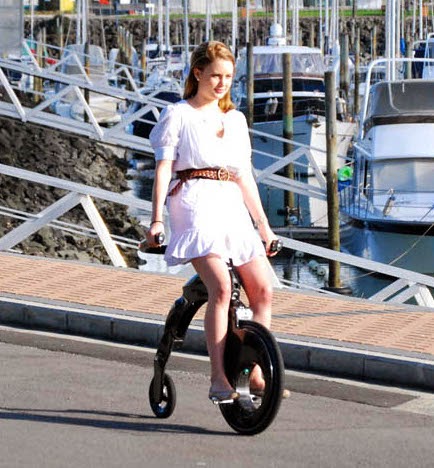
The YikeBike is fully foldable in just 20 seconds and weighs in at a little over 10kg, and that was enough to get it into the Guiness Book of Records as the lightest and smallest electric bike in the world. It is a fully electric bike – there is no pedal option – and it is powered by a 37 volt lithium-ion battery that gives you a somewhat short 14-kilometre range with a 23kph top speed. According to all of the reviews I have read, it takes a while to master how to ride the thing correctly, but all raved about the product. Prices range from US$2000 to about US$4000, depending on the amount of carbon fibre you want.

So, if the answer to our urban mobility woes has been staring at us in the face all of this time, why don’t more of us get on our bikes? Cycling is good for us and cheap, but those three items above are quite expensive really for what they are. Yes, we may get fit cycling but in the past couple of years alone, over 40 cyclists have been killed in London and that, frankly, is a risk I will deter my children from taking for sure. But perhaps the key reason is that you are exposed to the elements – the cold, the rain, the excessive heat, the dust and the exhaust fumes. In short, whilst it may be the ecologically correct thing to do, it would appear that most of us would prefer it if it was someone else that was doing it.


