What’s Good for the Goose? JLR Discovers Chinese Copycatting – And Suddenly It’s Not So Funny
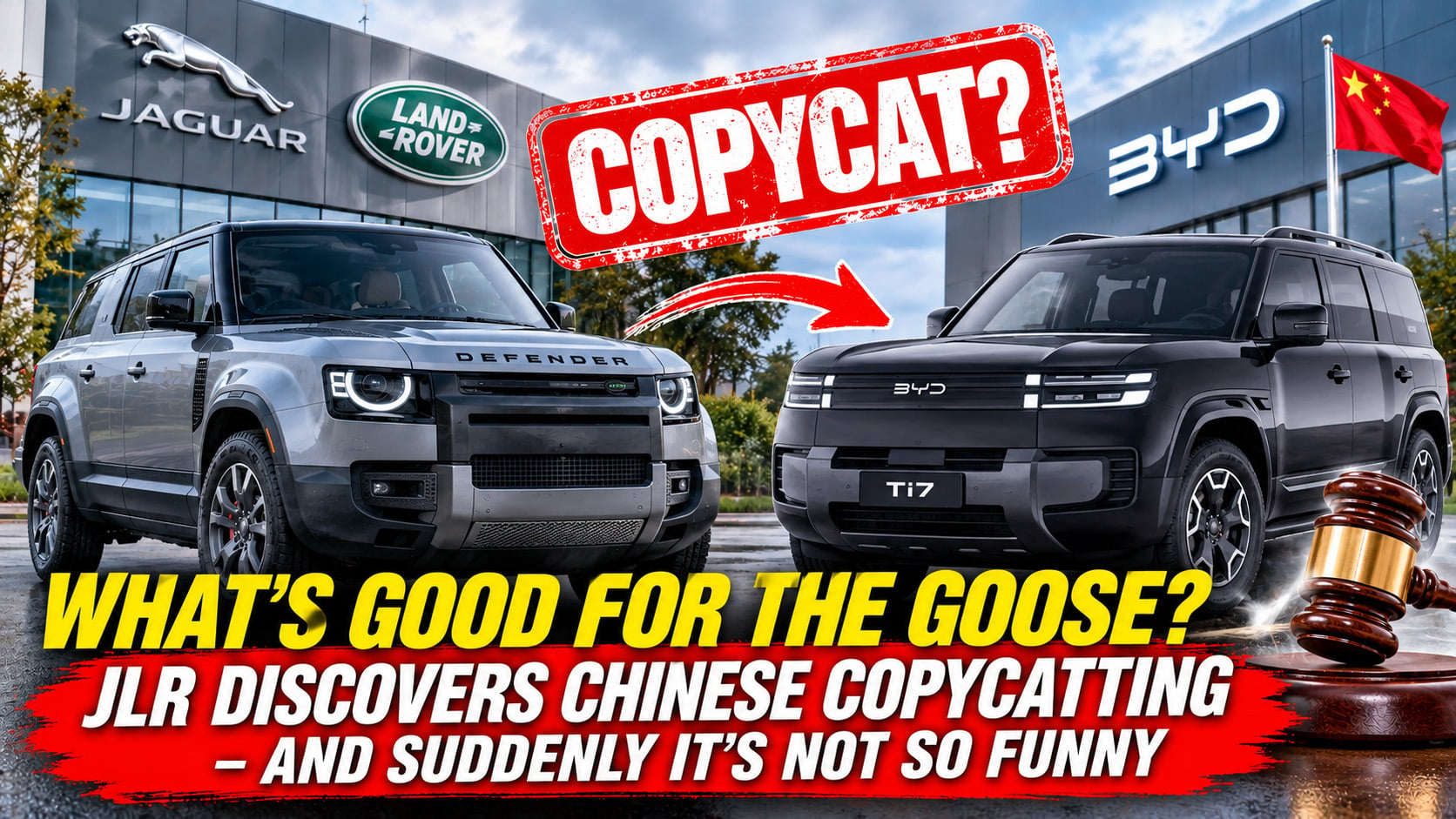
There is a certain irony in Jaguar Land Rover (JLR) taking the moral high ground over alleged Chinese automotive copying. After all, the British marque has spent years doing business with Chinese manufacturers. Perhaps it should have read the small print.
The latest episode involves BYD, whose new Ti7 SUV has attracted more than a passing resemblance to the Land Rover Defender. So much so that JLR has apparently decided that imitation is no longer the sincerest form of flattery.
According to reports, court-appointed bailiffs acting for JLR raided two BYD offices in the Netherlands back in August, seizing digital records. The suspicion is that BYD engineers may have dismantled a Defender and reverse-engineered elements of its technology during the development of the Ti7. BYD’s lawyers, unsurprisingly, have described the exercise as something of a fishing expedition.
Now, let’s be fair. Benchmarking competitors’ products is hardly unusual in the automotive industry. Manufacturers buy rival cars, strip them down, examine their engineering and learn from what they find. That’s called research. Using protected intellectual property without permission is quite another matter. The courts will have to decide where the line was crossed, if indeed it was.
But here’s where things get particularly interesting.
JLR has maintained a long-standing partnership with Chery, one of BYD’s biggest Chinese rivals. Their joint venture dates back to 2012, initially manufacturing Jaguar and Land Rover products for the Chinese market. Today, that relationship is evolving into the revival of the Freelander brand, with Chery playing a major role in its development.
Chery, of course, is hardly unfamiliar with accusations of derivative design. Its Jaecoo 7 has earned itself the affectionate nickname ‘Temu Range Rover’, while other models in its expanding portfolio bear more than a passing resemblance to familiar British off-roaders.
So, while JLR is busy accusing BYD of helping itself to Defender technology, it is simultaneously building its future with another Chinese manufacturer whose products have attracted remarkably similar accusations.
The uncomfortable truth is that China’s automotive industry has often been accused of developing products by dismantling, studying and replicating established Western designs rather than starting entirely from scratch.
Perhaps JLR has a legitimate grievance. But it might also want to consider whether its long-standing courtship of Chinese industry has helped create the very competitive environment it now finds so uncomfortable.
One thing is certain: when it comes to intellectual property, JLR would probably prefer that imitation remained a one-way street. And don’t forget we first wrote about this back in 2025