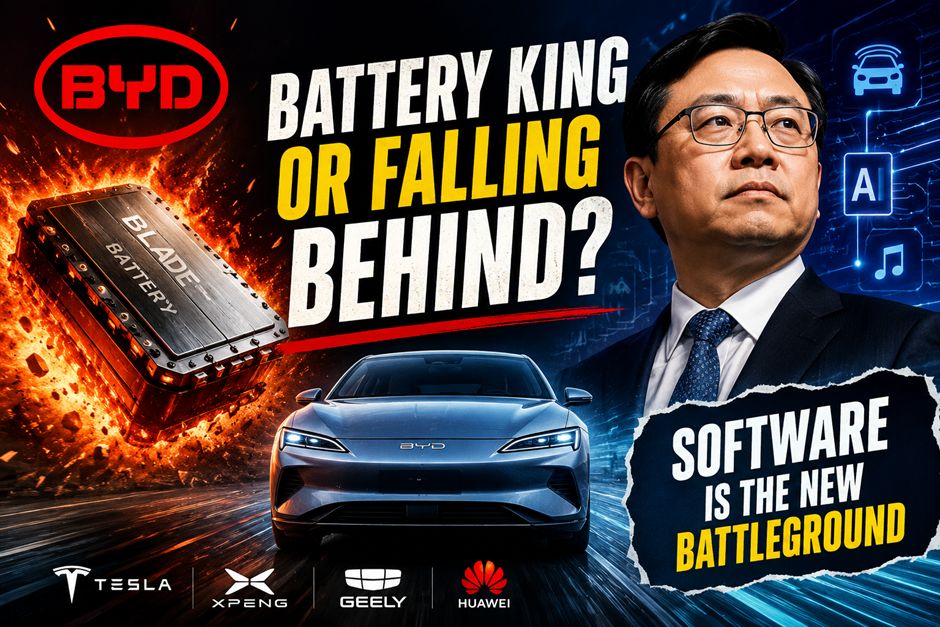
For years, visitors to BYD’s sprawling headquarters in Shenzhen have been treated to a rather theatrical demonstration. A conventional EV battery is drilled, catches fire, and erupts in a spectacular display of smoke and flames. Then a BYD “Blade Battery” is subjected to the same punishment and calmly shrugs it off.
It’s an impressive show, and it neatly sums up how BYD became the world’s largest electric vehicle manufacturer.
Unlike most carmakers, BYD didn’t start with cars. It started with batteries. Founder Wang Chuanfu built the company on an old-fashioned but highly effective principle: control everything. From lithium processing and battery production to semiconductors and artificial intelligence, BYD does as much as possible in-house. The result has been remarkable. The company has slashed costs, accelerated development and produced affordable EVs such as the Seagull, which sells in China for around US$10,000.
While Western manufacturers have spent years wrestling with supply chain shortages, BYD simply carried on building cars. Lots of them.
The strategy helped turn BYD into a giant, generating more than US$116 billion in revenue last year and even overtaking Tesla in vehicle sales during 2025.
However, cracks are beginning to appear.
China’s brutal EV price war has squeezed profit margins across the industry, and BYD is no exception. Operating profits fell last year for the first time in four years. Sales growth has slowed, and rivals such as Geely, Xpeng and Li Auto are increasingly attacking the market from a different angle.
The future battleground is no longer just batteries.
Today’s buyers, particularly younger consumers, are often more interested in software, connectivity and entertainment systems than battery chemistry. Many Chinese manufacturers are partnering with technology firms such as Huawei and AI specialists to rapidly improve autonomous driving, voice recognition and digital experiences.
BYD, true to form, insists on doing everything itself.
That approach has advantages, but it also carries risks. When technology evolves rapidly, partnerships can provide shortcuts. Developing everything internally means mistakes are yours alone to fix.
BYD still believes superior batteries and ultra-fast charging will keep it ahead of the pack. Yet as competitors rapidly catch up, it is becoming increasingly clear that in tomorrow’s automotive industry, batteries alone may no longer be enough to guarantee victory. BYD Built an Empire on Batteries – But Can It Win the Software War?