China Bans Flush Door Handles and Touchscreen-Only Controls: Common Sense Finally Wins
There was a time when carmakers competed by building the best engines, the most comfortable seats, or the smartest suspension systems. Today, some seem more interested in seeing just how many physical buttons they can remove.
I remember driving a Tesla Model 3 many moons ago. The acceleration was incredible instant power that could embarrass plenty of sports cars. The minimalist cabin also looked futuristic and refreshingly uncluttered.
But there was one thing that drove me absolutely mad.
If I wanted to open the glove compartment, I couldn’t simply pull a latch. Instead, I had to navigate through the touchscreen menu just to perform one of the simplest tasks imaginable. It felt less like driving a car and more like operating a tablet on wheels.
That might look impressive in a showroom, but it’s hardly practical in the real world.
China Has Had Enough
China has now become the first country to officially crack down on some of these questionable design trends.
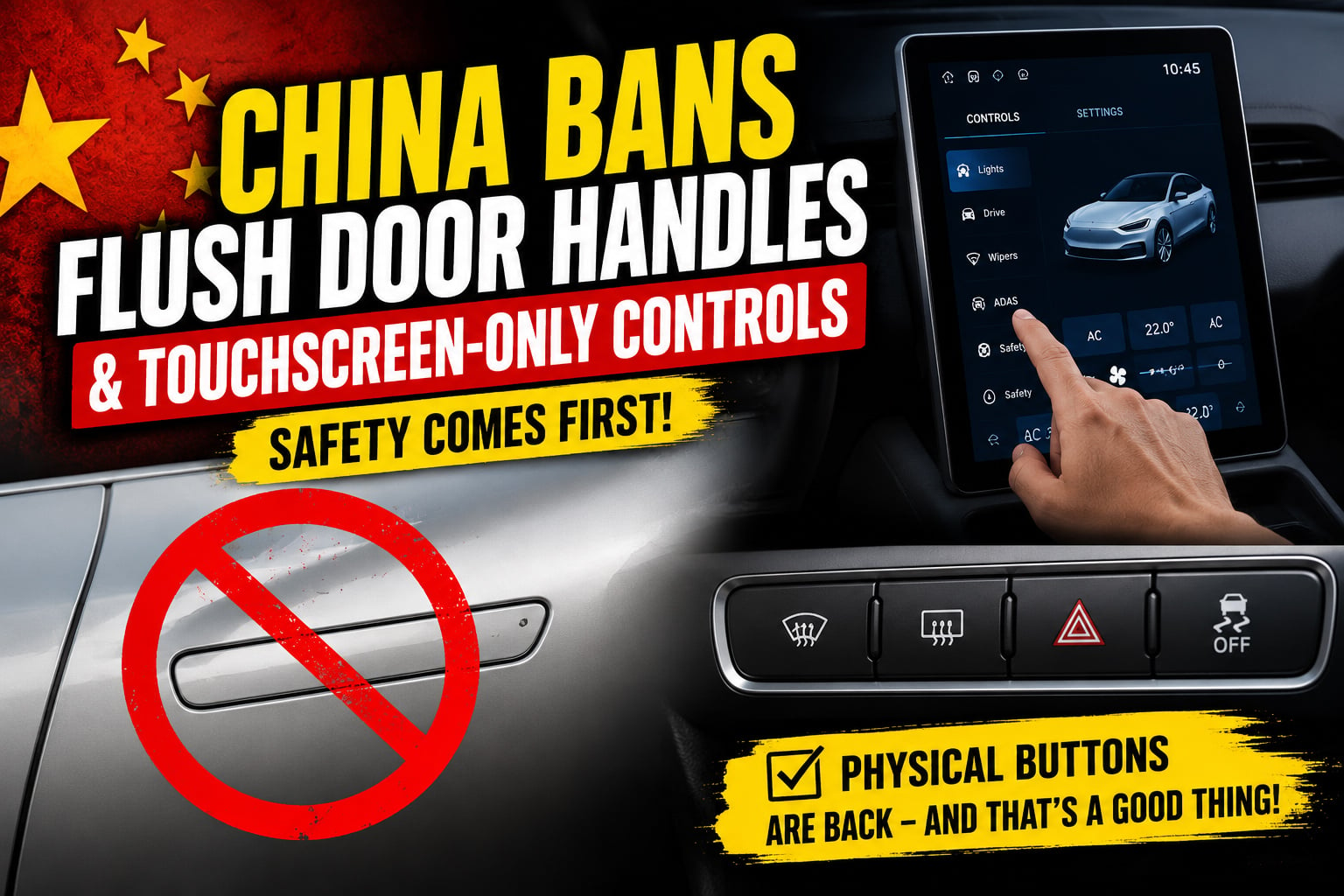
The Ministry of Industry and Information Technology (MIIT) has finalised new regulations that will require manufacturers to provide physical controls for essential vehicle functions beginning 1 July 2027.
The new rules cover functions such as:
- Exterior lighting
- Gear selection
- ADAS controls
- Windshield wipers
- Defroster and defogger
- Power windows
- Child or Accident Emergency Call System (AECS)
- Electric vehicle emergency power-off switch
The regulations also specify that these buttons must have a minimum operating area of 10 mm × 10 mm, making them easier to locate and operate without taking your eyes off the road.
Goodbye Flush Door Handles?
Another major casualty of the new regulations is the increasingly popular flush door handle.
While they may improve aerodynamics slightly and give cars a cleaner appearance, they’ve also been criticised for creating problems during emergencies. Hidden or electrically operated handles can make it more difficult for occupants or first responders to open doors after an accident, especially if electrical systems fail.
For something you rely on in an emergency, simplicity usually beats style.
Touchscreens Have Gone Too Far
I’ve noticed that in some overseas markets, even vehicles like the rugged-looking Jetour T2 rely almost entirely on the touchscreen to control the air conditioning.
Changing fan speed or temperature means digging through menus instead of simply reaching for a knob.
Thankfully, the Malaysian-specification model retains physical climate control buttons.
That alone makes it far easier and safer to use while driving.
There are even videos online showing owners fitting aftermarket physical buttons because they became so frustrated with the touchscreen-only setup. That says plenty about how drivers actually feel once the novelty wears off.
Safety Should Always Come First
Let’s be honest.
When you’re behind the wheel, your attention belongs on the road not on searching through menus just to adjust the air conditioning or activate the wipers.
A touchscreen demands visual attention. A physical button can usually be found by feel alone.
That’s exactly why aviation, heavy machinery and countless other safety-critical industries continue to rely on tactile controls for essential functions.
Cars shouldn’t be any different.
Minimalism certainly looks good in marketing photos, but good design should make a vehicle easier to use not harder.
China’s latest regulations recognise that technology should improve safety rather than compromise it.
Hopefully, other countries and more importantly, more manufacturers will follow suit.
Sometimes, progress means knowing when to bring the buttons back.