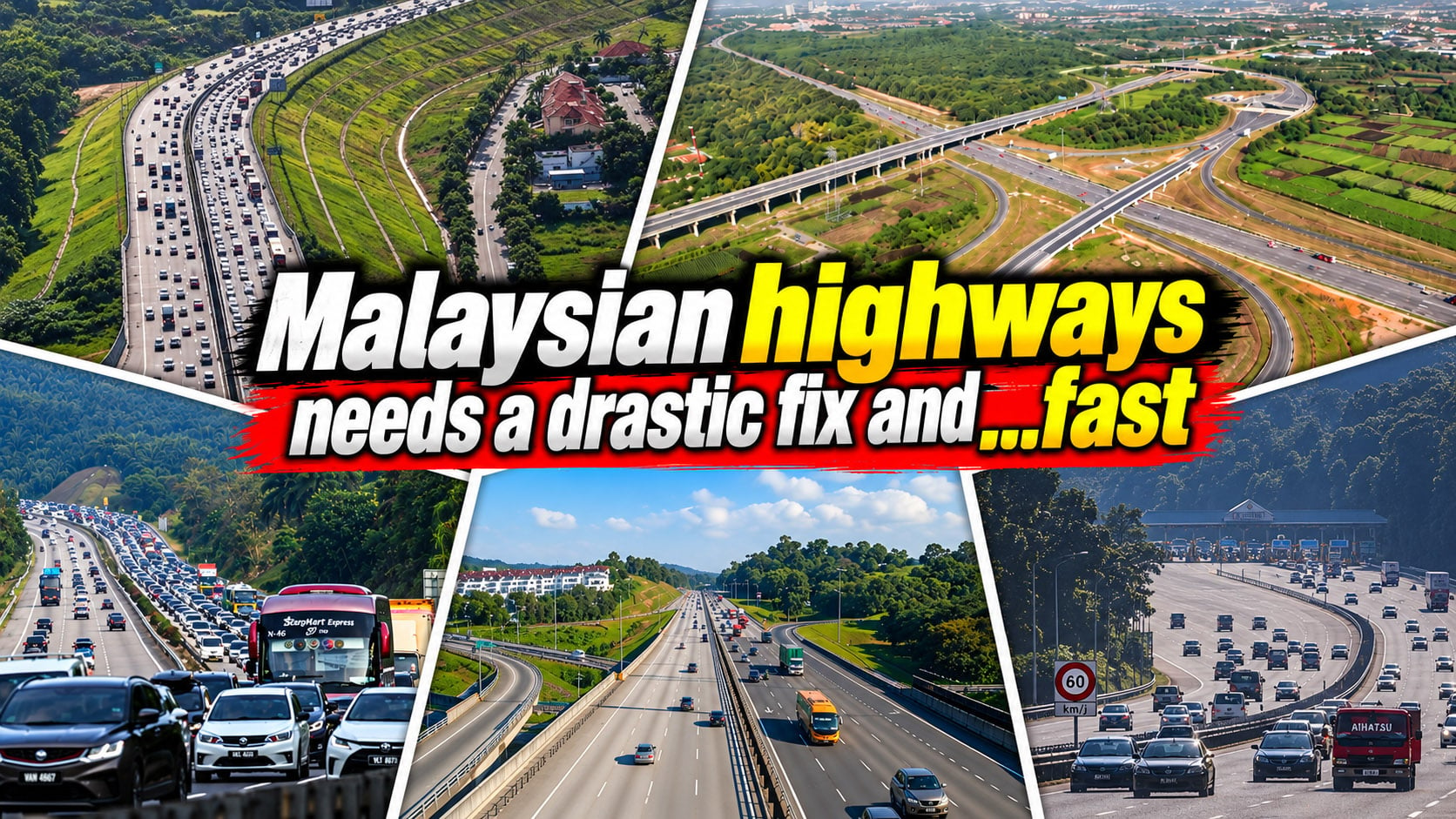
Having travelled on many of the roads in Peninsular Malaysian, we are blessed with great connectivity to all states. In Kuala Lumpur for instance, you will find highways in every direction linked somewhat to one another to make it easier for us commuters.
Compared to many countries in the region, we have a vast expansive network.
However, there is this niggling issue that has been the bane for motorists far the past few decades. It is the North-South Expressway (NSE). You see, this route is the one most plied by us drivers.
Originally designed more than three decades ago, are struggling to cope with today’s growing traffic demands, fuelled by increased interstate travel, rising commercial freight volumes, and the rapid growth of the digital and e-commerce sectors.
The travelling I do can cover almost 10,000km in a month. Heck, I did 4000km in less than 2 weeks! (and yes, my BUDI95 quota has been completely used up). The grouse here is the travelling time.
You see, I was stuck in an extremely bad crawl from Johor Bahru to Klang Valley which took almost 7 ½ hours. It was on a weekend and there was a heavy downpour. The stretch from JB right up to Yong Peng was a crawl in my terms – slow moving traffic coupled with the volume of vehicles on the road. It should have taken, if I’m being generous, six hours max.
That is fuel burning to its almost absolute worst. Now imagine the crawl when we travel to our hometowns for balik kampung. I’ve heard of cases where it took almost 20 hours! Easier and quicker vehicle ownership also contributes to the influx of vehicle on the road.
This can be solved and I believe the federal government is doing their fair share to get up to speed. But it needs to happen faster. As fast as how a skyscraper is erected every other day in Kuala Lumpur.
Herein lies the main challenge where a major part of the roads are two lanes. In this day and age, that is a big no-no. Fatigue wears in after such a long drive (yes I did take quick breaks). But there are other drivers that don’t and this can lead to accidents if the body is not rested well enough.
Experts observe that the Malaysian Highway Authority (LLM) often addresses traffic congestion by proposing additional highway concessions. However, urban planners caution against induced demand, where expanding road capacity may provide short-term relief but eventually encourages greater car ownership and road usage, causing congestion to return over time.
The strain extends beyond the roads themselves, with rest and service areas (R&R) along major highways struggling to accommodate growing demand for parking spaces, restroom facilities, food outlets, and electric vehicle (EV) charging stations.
I have also seen accidents almost happen in front of my eyes. As I was driving on this two-lane highway, in front was a Perodua Kenari, on the left a tanker. As we were about to pass the tanker, suddenly, it signalled to the right and turned to overtake another tanker in front of it and it pushed the Kenari to almost hit the guard rails. I kept honking to alert the tanker and thankfully the Kenari driver was aware too to hit the brakes hard. Otherwise, it would be a different story.
As you can see, these things happen. It only takes a second cause an accident. If it were a four-lane highway, the tanker would definitely be on the left most lane and could take his/her time and safely pass a slower moving vehicle.
So while we wait with bated breath as to when our highways will have a major revamp, let’s look out for each other on the road.