There was a time when people imagined NASA as a sort of giant engineering fortress, a place where brilliant scientists designed rockets, built them, tested them, launched them, and fixed them all under one very large government roof.
That might have been close to the truth during the heroic early days of the Apollo Program. But modern spaceflight doesn’t quite work like that anymore.
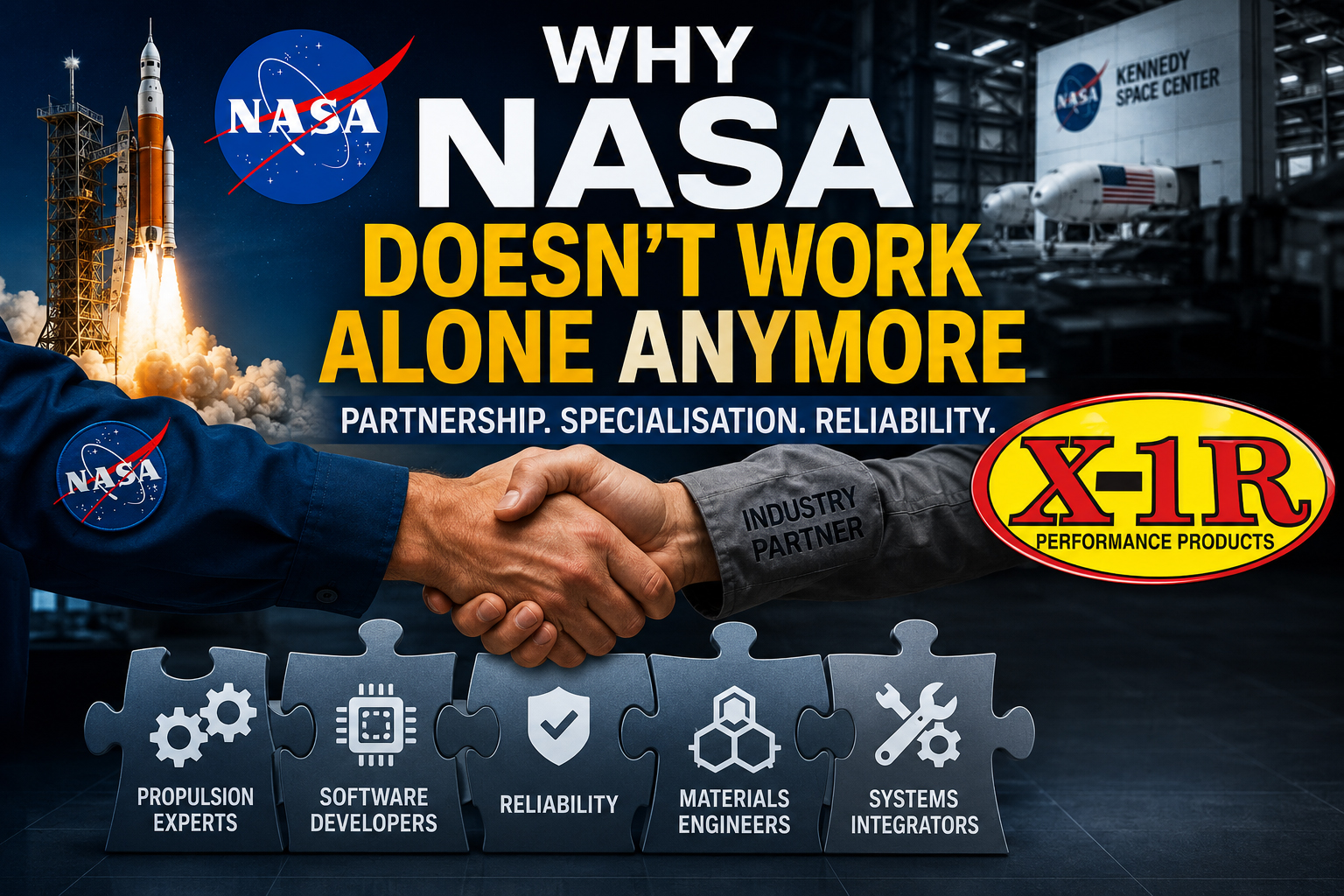
Today, NASA behaves less like a lone builder and more like a systems integrator, coordinating a vast network of specialised partners. Private aerospace companies, advanced materials engineers, propulsion experts, software developers and technology innovators all contribute their particular expertise.
In other words, rather than trying to do everything itself, NASA now works with people who already do one thing exceptionally well.
It turns out this approach has some rather useful advantages.
First, accountability improves. When each organisation is responsible for a specific piece of the puzzle, standards become clearer and performance becomes easier to measure. Second, innovation tends to accelerate. Specialists push their technology further because their entire business depends on mastering that one field.
And most importantly, reliability improves.
Space missions consist of thousands upon thousands of interconnected components. Every valve, bearing, sensor and line of code has a role to play. When each piece is developed by experts focused on their particular discipline, the entire system becomes far more predictable.
Interestingly, the same philosophy applies much closer to home, inside the workshop that services your car.
No single product keeps an engine healthy. Reliability comes from a system working together: proper lubrication, effective cooling, clean combustion, good filtration and sensible maintenance habits. Neglect one of those areas and the others soon start carrying extra stress.
Which is precisely why support technologies like X-1R exist within the broader maintenance ecosystem.
Rather than promising dramatic horsepower miracles, X-1R focuses on something far more useful: reducing friction and internal wear so mechanical components operate more smoothly over time. In demanding environments connected with the wider space program, including operations at the Kennedy Space Center, controlling friction isn’t about speed or spectacle.
It’s about predictability.
And there’s another advantage closer to Earth. X-1R adds a valuable service opportunity for workshops, allowing mechanics to offer preventative protection that helps engines run smoother, last longer and operate more efficiently.
Which brings us neatly back to NASA’s modern philosophy.
Progress rarely comes from shortcuts.
It comes from dependable partners quietly doing their job well.
NASA doesn’t rely on heroes anymore.
It relies on disciplined collaboration, where every component, every system and every partner performs its role with precision.
And in engineering, that’s exactly how the strongest systems are built.