Could China’s Used Car Boom Be About to Cannibalise Its Own New Car Market?
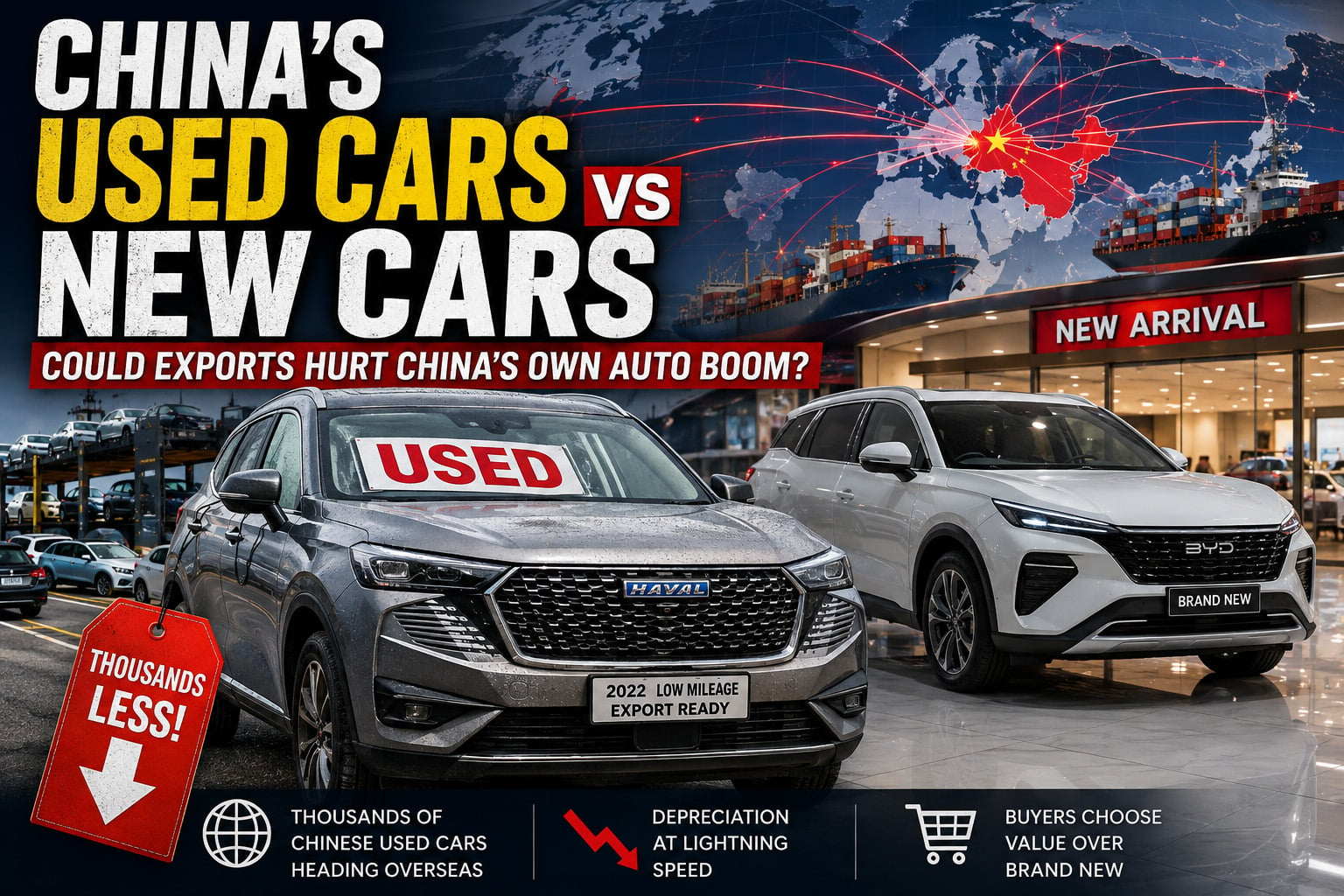
For the past five years we’ve been told that China’s master plan is to conquer the world’s new car markets. BYD, Geely, Chery, MG, GWM and dozens of others have invested billions in developing global dealer networks, manufacturing plants and marketing campaigns designed to persuade motorists to ditch the traditional Japanese, Korean and European brands.
But what if China’s biggest competitor isn’t Toyota or Volkswagen?
What if it’s… China?
A fascinating trend is beginning to emerge as thousands of Chinese used cars find their way onto international markets. Dealers are advertising directly to overseas buyers, complete with prices in US dollars and shipping arranged to almost any port you care to name.
At first glance it seems like an obvious way to clear surplus stock from the world’s largest car market.
However, there may be an unintended consequence.
Imagine you’re a dealer in Southeast Asia, Africa or South America. You can buy a brand-new Chinese SUV for US$25,000, or a two-year-old version with all the same gadgets, barely any mileage and thousands of dollars knocked off the price.
Which one are you going to stock?
Motor dealers have always followed the numbers rather than the marketing brochures.
China’s domestic market is producing almost the perfect export product: modern, well-equipped cars depreciating at astonishing speed because over 500 new models have been launched this year alone. Yesterday’s flagship quickly becomes today’s bargain.
That creates an opportunity which independent importers won’t ignore.
The biggest casualty could be the very manufacturers hoping to dominate global new-car sales. Every nearly-new export is potentially one less brand-new vehicle sold through an official dealership.
Europe could feel the pressure first in the budget EV sector, Australia may see independent importers testing the waters, while Southeast Asia—with its price-sensitive consumers and established grey-import culture—looks particularly vulnerable.
The irony is delicious.
China’s manufacturers have become so efficient at producing new vehicles that they may have inadvertently created a second industry capable of competing directly against them.
Of course, official dealers still have powerful advantages. They offer manufacturer warranties, finance packages, servicing, software updates and customer support that independent importers often struggle to match.
But when household budgets are stretched and buyers are looking for value above all else, a three-year-old Chinese SUV at half the price of a new one suddenly becomes a very compelling proposition.
History has a habit of repeating itself. Japanese manufacturers built their reputations by exporting affordable new cars in the 1970s. Thirty years later, Japanese used imports transformed markets from Kenya to New Zealand.
China may be about to write the next chapter.
The question isn’t whether Chinese used cars will reshape global markets.
The question is whether they’ll reshape China’s own automotive ambitions at the same time.