Rockets Succeed Because They Are Predictable, Not Because They Are Powerful
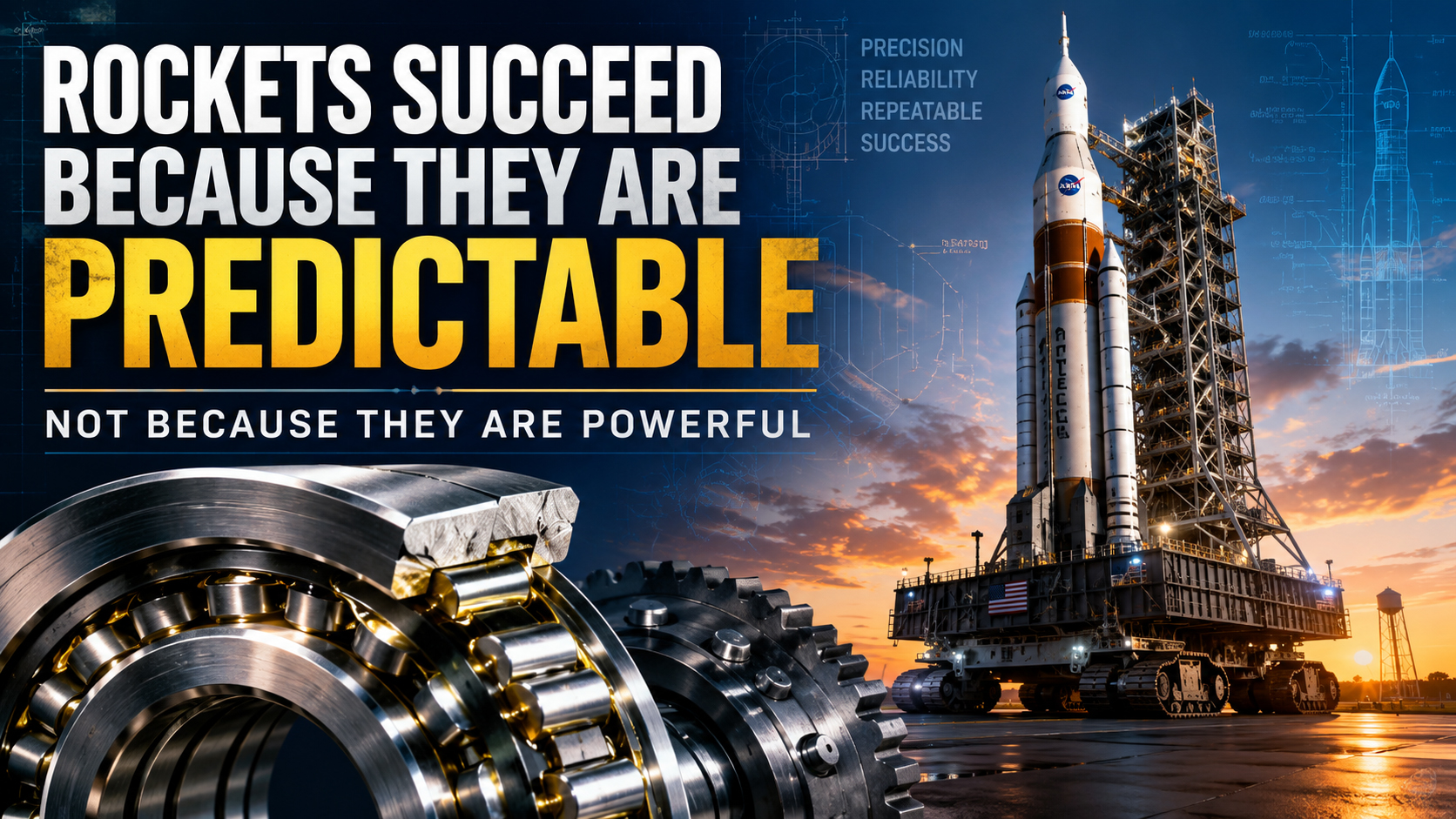

When most people picture rockets, they imagine thunder, fire, and an earth-shaking blast of raw power. Fair enough, a launch certainly looks dramatic enough.
But here’s the slightly less glamorous truth.
Space missions succeed not because rockets are powerful, but because they are predictable.
At organisations like NASA, predictability is the holy grail of engineering. Every valve, every seal, every bearing and electrical circuit must behave exactly as expected. No improvisation, no sudden surprises and certainly no “let’s see what happens next.”
A rocket launch is not an exercise in creativity.
It’s the ultimate demonstration of disciplined engineering, where thousands of components operate together in controlled harmony.
Long before the modern Artemis Program came along, NASA already understood this principle perfectly well. Even the machinery that never left the ground had to meet astonishing reliability standards.
Take the mighty Crawler-Transporter at the Kennedy Space Center.
This enormous machine is one of the heaviest self-powered vehicles ever built, responsible for carrying fully assembled rockets from the Vehicle Assembly Building to the launch pad. It doesn’t race along like a sports car. In fact, it moves at about the speed of a leisurely stroll while transporting thousands of tonnes of rocket and launch platform.
Speed is irrelevant. What matters is controlled motion, balanced loads and carefully managed friction.
Because when you’re moving a multi-billion-dollar launch vehicle, excessive wear or mechanical failure isn’t a maintenance issue, it’s a mission risk.
That’s precisely where X-1R entered NASA’s operational environment. For 31 years, X-1R has been used at the Kennedy Space Center because it has proven, time and again, to deliver superior lubrication performance; quite simply better than anything else on the market.
The goal was never flashy marketing claims or dramatic short-term gains. It was stability. Consistency. Mechanical systems operating smoothly under heavy stress with minimal friction and wear.
In other words, exactly the qualities that make space missions possible. Interestingly, the same lesson applies to engines here on Earth.
Reliability doesn’t come from pushing harder or running hotter. It comes from managing friction, heat and stress before they turn into expensive mechanical drama. When internal components move smoothly and predictably, engines last longer and operate more efficiently.
Which brings us back to rockets.
In engineering circles, the highest compliment you can give a machine isn’t “powerful.”
It’s “dependable.”
Because when every system behaves exactly as expected, success stops being a lucky event and becomes something far more valuable.
Repeatable.