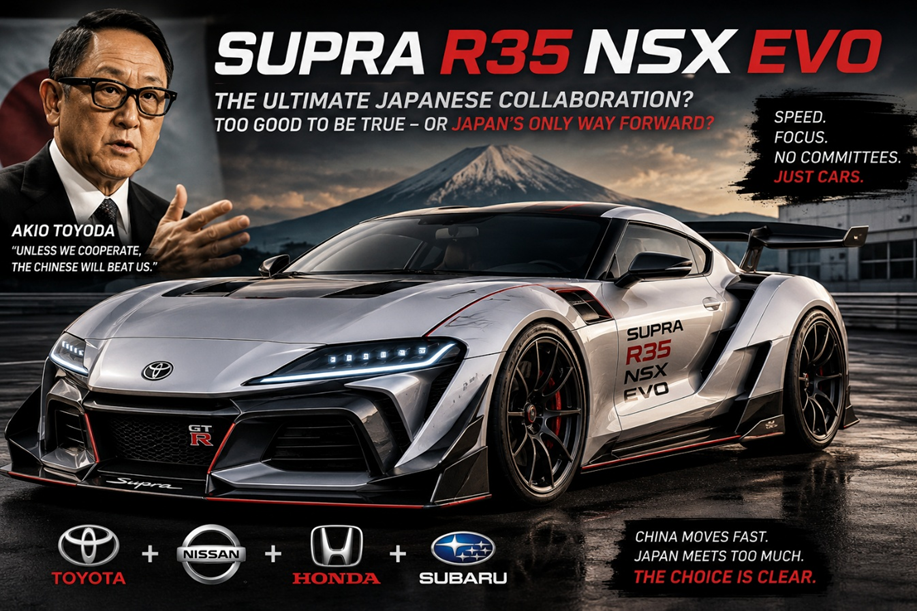
If you follow this Blog then you will know that we respect Toyota CEO Akio Toyoda, he is a visionary. So recently he warned that unless Japan’s car manufacturers learn to cooperate more closely, the Chinese will simply outpace them. It’s a fascinating observation, particularly coming from a man whose company has spent decades showing the rest of the world how to build cars properly.
But it does raise an intriguing question.
If collaboration really is the future, are we about to witness the arrival of a Toyota Supra R35 NSX Evo? Imagine the badge engineering possibilities. A Nissan GT-R chassis, a Honda-developed hybrid system, Toyota reliability and perhaps a Subaru all-wheel-drive system thrown in for good measure. It sounds like the sort of thing petrolheads would have dreamt up after three pints at the pub.
History, however, suggests we should be careful what we wish for.
The automotive industry has never been short of grand mergers and ambitious mega-groups, yet their track record is hardly inspiring. Britain offers perhaps the best cautionary tale. A thriving collection of fiercely independent manufacturers gradually became the nationalized British Leyland, a sprawling empire where committee meetings seemed to replace engineering. That eventually evolved through the Rover years under BMW ownership before disappearing into history altogether.
Fast forward to today and we have Stellantis, a corporate giant with more brands than most people can remember. On paper, the economies of scale look irresistible. In reality, managing such an enormous collection of marques, cultures and product lines appears to be rather more complicated than the PowerPoint presentation suggested.
Meanwhile, the Chinese seem to be playing an entirely different game.
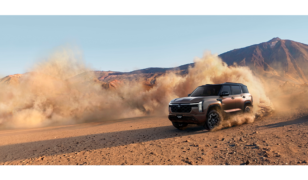
Companies such as BYD, Geely and Chery aren’t burdened by decades of tradition or internal politics. They aren’t spending five years debating whether a grille should be 10 millimetres taller to preserve brand heritage. They identify a market opportunity, make a decision and get a product into showrooms while their competitors are still scheduling the next strategy workshop.
That speed to market may be the single greatest competitive advantage China possesses.
It’s not necessarily because their engineers are smarter or their factories more efficient, although many undoubtedly are extremely capable. It’s because decisions happen quickly. Layers of management are thinner, historical baggage is lighter and there seems to be a willingness to accept that perfection tomorrow is often less valuable than being very good today.
And just how do you battle all of those Sate subsidies that they get?
Japanese manufacturers certainly need to adapt if they want to remain competitive, but cooperation alone won’t be enough. Simply making bigger organizations rarely makes them faster. In fact, history suggests it often achieves precisely the opposite.
Perhaps the real lesson from China isn’t that everyone should merge.
It’s that sometimes the fastest car wins the race, not because it’s more powerful, but because nobody held a committee meeting before turning the key.