Automologist HAROLD does not think so, at least not in his lifetime…

Ten to fifteen years later than most Western countries, the Republic Act no. 11697, better known as the Phillipine’s Electric Vehicle Industry Development Act, finally lapsed into law without former President Rodrigo Duterte’s signature. It is being highlighted by its proponents as a possible game-changer in the fight to clean up the local transportation sector and reduce dependence on fossil fuels.
What exactly is it? The intent of the law is to accelerate the local electric vehicle (EV) industry and catch up with the rest of the world. To exactly know what the law is all about, especially for regular motorists like yourselves, you will have to go through the entire bill—which many of you don’t have the patience for.
For your convenience, the most important parts of the Electric Vehicle Industry Development Act are summarized for you below:
In Summary.
The Electric Vehicle Industry Development Act includes a long list of objectives. To sum it up, its aim is to create a more conducive environment within the Philippine Transportation industry for the development and use of EVs. The dream is that with mass adoption, more jobs will be generated, a new industry will blossom, and Filipinos will be healthier and better protected from the greenhouse effect. But what will happen to those who are currently employed in the industry selling internal combustion engine vehicles? Will the new jobs and opportunities created compensate for the dislocated sectors?
The Agenda.
To implement the Electric Vehicle Industry Development Act, a national development plan for the local EV industry must be adhered to in order to accelerate EV adoption, commercialization, and development. This is referred to as the Comprehensive Roadmap for the Electric Vehicle Industry (CREVI).
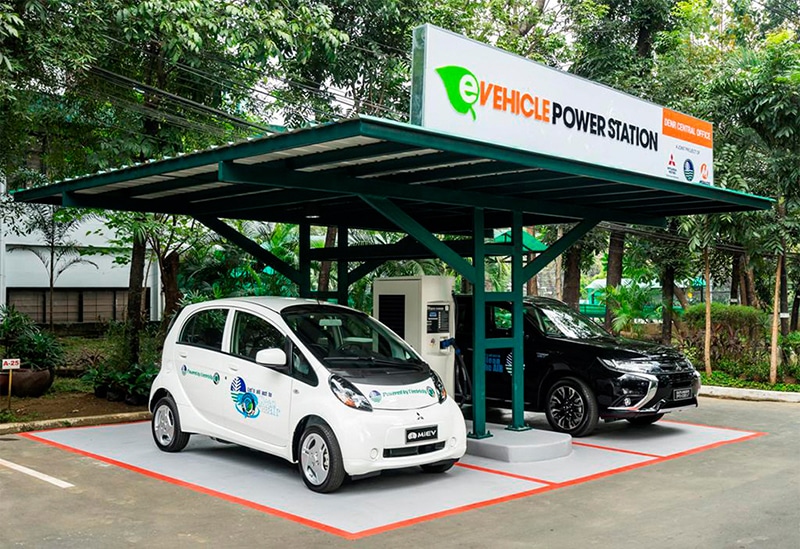
Some of the most important points of the CREVI will include the development and installation of EV charging stations, the dedication of parking slots to EVs, manufacturing standards for EVs and EV-related components, as well as the overall promotion and adoption of EVs. This lofty agenda will take about 15 to 20 years to achieve, particularly the setting up of nationwide charging stations and provision for dedicated EV parking lots. You may remember that in the Philippines, it took about 15 to 20 years for a skyway from Alabang to Balintawak to be finished. So, for a nationwide charging network, a good 20 years will not be enough to build it.
Exemption from Number Coding Scheme.
No need to buy a second car just to avoid the number coding scheme. Instead, just switch over to an EV. EVs will be exempted from the Unified Vehicular Volume Reduction Program. This exempts EVs from both enforcement by the Metropolitan Manila Development Authority (MMDA) and local government units that implement number coding (Makati City in particular). Here’s more: EVs will be issued a special type of license plate by the Land Transportation Office (LTO). A question to ponder in the first place is: “Is the number coding an effective way to reduce vehicular traffic, and will it continue to be implemented?”
Discounts on Registration Fees.
Many will jump on the bandwagon as soon as prices go down because EV users are in for some sizable discounts when registering their vehicle with the LTO. Under the CREVI, battery electric vehicle (BEV) owners are entitled to a 30% discount on the motor vehicle users charge (MVUC), while hybrid owners get 15% off. Moreover, BEV and hybrid users will have the registration process expedited for them. These discounts will also apply to EV and hybrid inspection fees for the first eight years from the Act’s effectivity.
Expedited Registration.
Good news to Public utility vehicle (PUV) operators with EV units as their EVs will also have their franchise applications expedited by the Land Transportation Franchising and Regulatory Board (LTFRB). The same goes for EV importers and manufacturers bringing in units through the Bureau of Customs (BOC). The big question is: “Can PUV Operators afford the high cost of EVs and will the present fares rates be enough to make their operations profitable?” Increasing fares can cause inflation-related ripples.
Dedicated Parking Slots for EVs.
The CREVI mandates that all private and public buildings must have parking slots dedicated to EVs. At least 5% of slots must be exclusive to EVs. This applies to all new buildings constructed after the Act’s effectivity, as well as existing ones (which will be given a timeline to comply with the requirement). Any establishment that fails to comply with this requirement may be denied permits. The 5% requirement is ill-thought of. It is actually saying that in the long term, only 5% of vehicles on the road are EVs? You call that a comprehensive shift?
5% of Fleet must be EVs.
The CREVI further requires all industrial and commercial entities like logistics companies, tour agencies, hotels, and utility companies to have EVs make up at least 5% of their fleets. Same goes for PUV operators, transport network vehicle service operators like Grab, as well as LGUs and government agencies. A timeline will be provided for compliance with this requirement. Again, why 5%? Is this a magic number? Or it actually says we are only 5% serious about EVs?
EV Chargers Required In Gas Stations.
The CREVI also requires gas stations to provide designated spaces for the installation of commercial chargers for public use. Installation, maintenance, and operation will be handled by either the owner or a charging station service provider, though the latter will be given priority. Failure to comply with this requirement will result in the non-issuance of permits.
Designating ‘Green Routes’ for PUVs.
The Department of Transportation (DOTr) will be responsible for approving ‘Green Routes’ to be included in the LTFRB’s route plans for provinces, cities, and municipalities. These are routes that will be exclusively traversed by electric PUVs. The proponents of this act forgot that we have limited streets, in fact among the lowest in Asia, and designating some of them exclusively for EVs is traffic “Armageddon” in the making.
Exemption from Import Duties and Excise Tax.
The Electric Vehicle Industry Development Act mandates that the importation of completely built EVs shall be entitled to tax incentives under the Tax Reform for Acceleration and Inclusion (TRAIN) law. This would mean that hybrids will only be subject to 50% of applicable excise taxes, while full EVs will be exempt from excise taxes on automobiles altogether. The catch is that the Department of Finance (DOF) may suspend these exemptions “in order to protect local manufacturers”. The importation of completely built EV charging stations, meanwhile, will be exempt from the payment of duties for the first eight years from this Act’s effectivity. This will create a revenue shortage in the country’s tax revenues.
Worth noting is that under this Act, the Bangko Sentral ng Pilipinas (BSP) is tasked with encouraging banks to lend a certain percentage of their portfolio to EV manufacturers, assemblers, and charging station operators. But banks are notorious at circumventing BSP rules. Case in point: have they complied with the law allocating specific percentage of their loan portfolio to small and medium scale businesses?
EV Training & Personnel Development.
Technical Education and Skills Development Authority (TESDA) will provide training programs for the assembly, use, maintenance, and repair of EVs.
NO Implementing Rules and Regulations (IRR) Yet!
No IRR yet, which means we’re still a while off from the Electric Vehicle Industry Development Act becoming a real solid piece of enforceable legislation. The DOTr, Department of Energy (DOE), Department of Trade and Industry (DTI), together with other relevant government agencies and private stakeholders must produce the (IRR) for this act within 120 days of its effectivity and “failure of the relevant government agencies to promulgate the IRR within the specified period shall subject the heads of these government agencies to administrative penalties under applicable civil service laws.”
REALLY? Look around, there are hundreds of laws being passed in the last 20 years with no IRRs. Where is the IRR for the Anti-Monopoly Law? IRR for the Anti-Political Dynasty Law? Never heard of cabinet secretaries sanctioned for not issuing an IRR. This is a major flaw in our law-making. We are good at making laws but very poor at implementing them.
IN THE MEANTIME, as we await the full EV dispensation, which will not happen during this writer’s lifetime, the question is are we exploring all means available to save fuel and reduce air pollution (the main objectives of EVs) while we still drive our fossil-fuel-fed cars? Hundreds of thousands of car owners have already discovered the secret to fuel savings and pollution control: the NASA-certified product X-1R Engine and Fuel Treatments. These are available in most service departments of franchised car dealerships. Ask your service advisors for it.
You can also call +63 956 809 5284 or message X-1R Philippines at .facebook.com/X1RPhilippines.