Europe’s Heatwaves and the Awkward Theory Climate Campaigners Would Rather You Didn’t Read
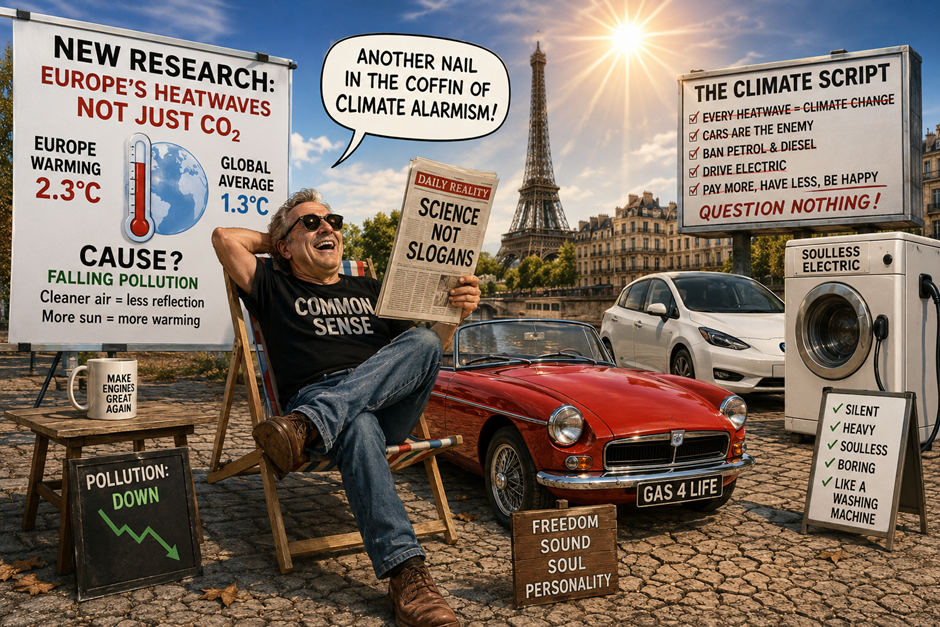
For years we’ve been told that every heatwave, flood, drought or unusually warm Tuesday afternoon is yet more proof that mankind’s beloved internal combustion engine is plotting the destruction of civilisation. The solution, naturally, is to surrender the keys to our petrol-powered pride and joy and embrace an electric SUV with all the charisma of a washing machine.
Then along comes science to make life inconvenient.
Recent research has suggested that Europe’s exceptionally rapid warming, estimated at around 2.3°C above pre-industrial levels, noticeably higher than the global average of roughly 1.3°C, isn’t simply down to greenhouse gases. A significant contributor appears to be something rather ironic: cleaner air.
As Europe has successfully reduced sulphur emissions and other airborne pollutants, the atmosphere has become clearer. Those pollutants, undesirable though they were for human health, also reflected a portion of incoming sunlight back into space. Remove them and more solar energy reaches the surface, amplifying regional warming. It’s a phenomenon scientists have discussed for years, but one that rarely features in the dramatic headlines predicting the apocalypse.
None of this means carbon dioxide has no warming effect, nor does it mean pollution was somehow beneficial overall. Dirty air killed people and reducing it has been a major public health success. But it does remind us that climate is a fiendishly complicated system where multiple factors interact, often in unexpected ways.
Which rather spoils the comforting simplicity of “cars equal heatwaves.”
Unfortunately, nuance has never been fashionable. It’s much easier to blame your ageing diesel estate than admit that successful environmental policies can produce side effects that complicate the narrative.
Meanwhile, the rush to electrify everything continues with almost religious zeal, despite slowing consumer demand, enormous subsidies and manufacturers quietly discovering that customers aren’t quite as enthusiastic as politicians expected. Funny that.
Perhaps the real lesson is that science is supposed to challenge assumptions, not reinforce political slogans. If new evidence forces us to refine our understanding of why Europe is warming faster than the rest of the planet, that isn’t a crisis for science, it’s science doing exactly what it’s meant to do.
The climate debate deserves more curiosity and a little less certainty. And until then, don’t be surprised if plenty of motorists continue hanging on to their petrol cars, personality included.