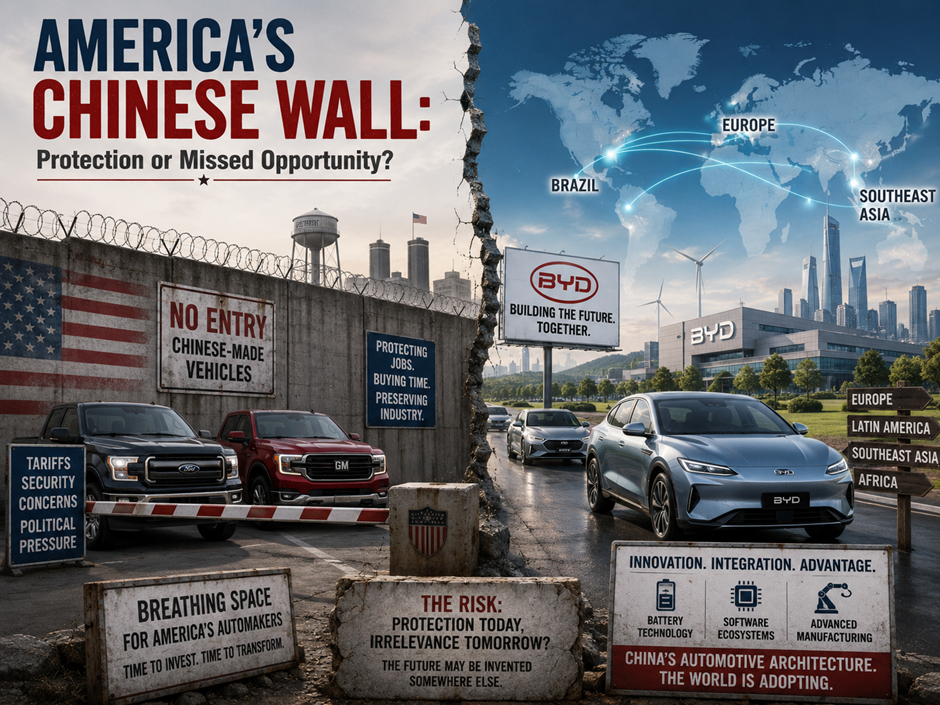
The United States has effectively slammed the door on Chinese-made vehicles. Through a combination of tariffs, security concerns and political pressure, Washington has made it abundantly clear that Chinese carmakers are not welcome at the party. The question is whether this will prove to be a masterstroke of industrial policy or a costly strategic error.
In the short term, the answer appears straightforward. America’s legacy manufacturers, particularly the traditional giants in Detroit, have been granted a breathing space. Without an influx of lower-priced Chinese electric vehicles, companies such as Ford and General Motors have more time to restructure, invest in new technologies and protect domestic jobs. Workers in Michigan and Ohio are undoubtedly sleeping easier knowing that they are not yet facing direct competition from China’s automotive juggernaut.
However, history suggests protectionism can become a comfortable trap.
The danger for the United States is that by keeping Chinese competition out, it may also be keeping innovation at arm’s length. Chinese manufacturers, led by companies such as BYD, have achieved something remarkable. They have developed manufacturing architectures that integrate batteries, electronics and vehicle platforms in ways that dramatically reduce costs and improve production efficiency.
BYD, in particular, has largely shrugged off the American ban. Rather than obsessing over a market it cannot enter, the company has aggressively pursued opportunities in Brazil, Europe and Southeast Asia. It is building factories overseas, establishing dealer networks and introducing technologies that many competitors are struggling to match.
There is an uncomfortable historical parallel here. During the twentieth century, American manufacturers created the blueprint for global automotive production. Ford’s assembly line and General Motors’ manufacturing systems became the standard that the rest of the world sought to emulate.
The risk today is that China may be creating the blueprint for the twenty-first-century automobile.
If European, Latin American and Asian manufacturers increasingly adopt Chinese battery technologies, software ecosystems and production methods, the United States could find itself isolated from the industry’s new centre of gravity. Protection may preserve existing jobs for a period, but it could also reduce the urgency to innovate.
None of this means the United States should throw open its borders and welcome a flood of subsidised imports. There are legitimate concerns about industrial dependence and national security. But walls have a habit of keeping ideas out as well as competitors.
The great irony may be that while America protects itself from Chinese cars, the rest of the world quietly embraces Chinese automotive architecture, leaving Detroit to discover that the future has been invented somewhere else.