China’s Car Market Hits the Brakes; the Rest of the World Should Be Worried.
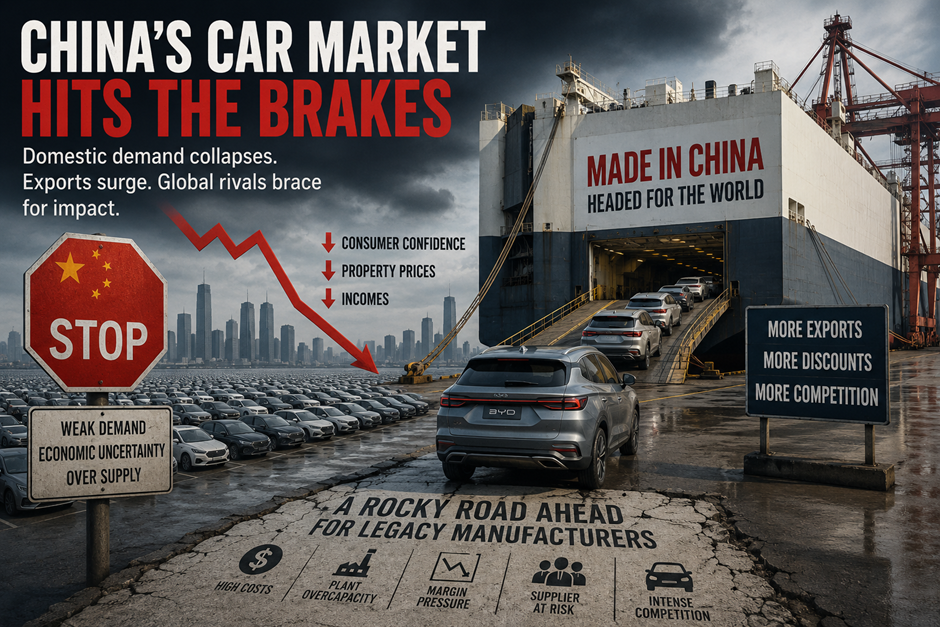
For years we have been told that China’s automotive industry was an unstoppable juggernaut. The country became the world’s largest car market, its electric vehicle makers rose from obscurity to challenge established brands, and factories were built at a pace that would make Henry Ford’s head spin. But suddenly the wheels are wobbling.
Domestic demand for new cars in China has weakened considerably. Consumers, facing economic uncertainty, falling property prices and stagnant wages, are simply not buying vehicles in the numbers manufacturers had expected. The result is a severe oversupply problem. China now has too many factories producing too many cars for too few buyers.
And what happens when you have excess production? You export it.
Expect to see even more Chinese brands aggressively targeting international markets, particularly in Southeast Asia, Latin America, Africa and even Europe. Massive discounts and cut-price financing deals could become the norm as manufacturers desperately seek customers abroad. In simple terms, Chinese automakers may increasingly resort to dumping product into overseas markets simply to keep their production lines running.
This could create a perfect storm for legacy manufacturers.
Established carmakers from Japan, Europe and the United States already face enormous challenges. The transition to electrification has demanded billions in investment, while increasingly complex regulations have squeezed profit margins. Now they may find themselves competing against a flood of heavily discounted Chinese vehicles, many backed directly or indirectly by substantial state support and low-cost supply chains.
The consequences could be painful. Manufacturers with high labour costs and expensive domestic production facilities may struggle to compete on price. Smaller suppliers and component manufacturers, the very backbone of many automotive economies, could face declining orders and factory closures.
The road ahead looks decidedly rocky.
Some legacy manufacturers will undoubtedly adapt through partnerships, localisation and improved technology. Others may find themselves in an uncomfortable battle against competitors willing to sacrifice margins in exchange for market share.
The collapse in Chinese domestic demand may appear to be a problem confined to Beijing and Shanghai. In reality, it could become a global issue. Because when the world’s largest car producer catches a cold, the rest of the automotive industry should probably start reaching for the tissues.