Britain’s Need for Speed; And Why JCB Thinks Hydrogen Is the Future
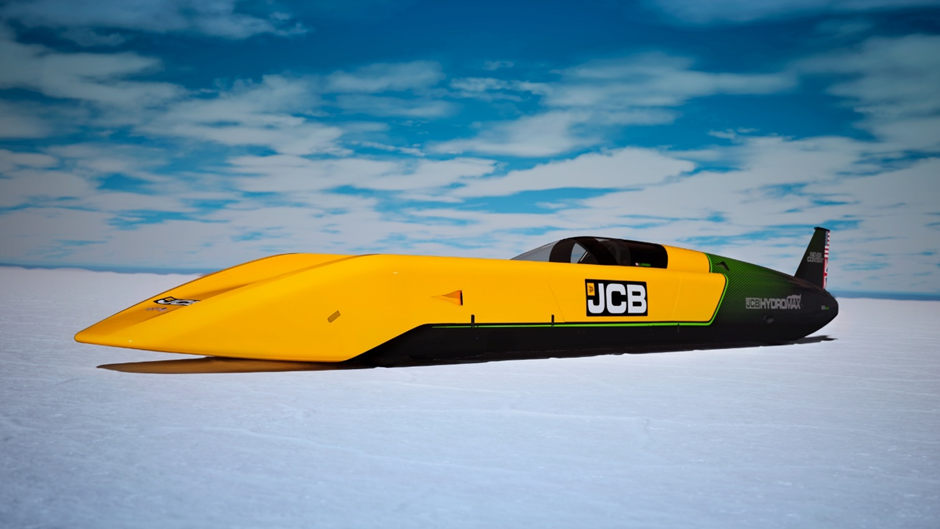
There is something wonderfully predictable about Britain. Give us an island with miserable weather, a shortage of sunshine and an alarming tendency to dig up our roads, and sooner or later someone will decide to build a machine capable of travelling at more than 400 mph.
This time it is JCB.
The British construction giant has just propelled its Hydromax to an astonishing 406.320 mph (653.909 km/h) across the Bonneville Salt Flats, making it the fastest hydrogen-powered vehicle ever recorded. At the wheel was Andy Green, the former RAF fighter pilot who rather inconveniently already holds the outright land-speed record of 763.035 mph, set in ThrustSSC in 1997.
Because apparently one world record wasn’t enough.
Britain’s obsession with going faster than anyone else is almost a national character flaw. From Malcolm Campbell and John Cobb to Donald Campbell’s Bluebird, Thrust2 and Green’s ThrustSSC, we have repeatedly responded to technological challenges with the same basic question: Yes, but how fast can we make it go?
JCB has form here, having used its Dieselmax project to set the diesel land-speed record in 2006. Now, 20 years later, it has returned to Bonneville with something rather more interesting than another diesel.
Hydrogen.
And unlike many automotive hydrogen projects, JCB isn’t betting on fuel cells. It is developing hydrogen internal-combustion engines, essentially taking the technology, manufacturing expertise and supply chains developed around conventional engines and teaching them a new trick. JCB has invested around £100 million in the technology, and its hydrogen engine has already secured full EU type approval.
The reason is actually rather sensible.
A two-tonne electric car can carry a rather large battery. A 20-tonne excavator working all day is another matter entirely. Downtime, charging infrastructure, battery weight and the sheer energy demands of heavy machinery make electrification considerably more complicated.
Hydrogen offers JCB the possibility of retaining familiar engines, rapid refuelling and the power and torque demanded by construction equipment, without simply replacing one enormous diesel fuel tank with an enormous battery.
The Hydromax is therefore more than a spectacular British mid-life crisis with wheels. It is a rolling engineering experiment.
And at 406 mph, it has certainly got our attention. Perhaps the future isn’t electric after all. Perhaps, very Britishly, it just needs to be faster.