Your Car Says RON95 Is Fine. Your Turbo Might Have Other Opinions.
You arrive at the petrol station. RON95 on one side, RON97 on the other. You look at the price difference. Your wallet makes the decision.
RON95 it is.
For most cars, that is perfectly fine. But then you notice a bottle labelled Octane Booster, promising higher octane, better performance and maybe even better fuel economy.
So, does it actually work? The short answer is: a properly formulated octane booster can work but your engine must be able to benefit from the extra octane.
Higher Octane Does Not Mean “More Powerful Petrol”
One of the biggest misconceptions is that RON98 somehow contains more horsepower than RON95. It doesn’t. RON, or Research Octane Number, mainly tells us how resistant petrol is to engine knock.
Normally, the spark plug ignites the air-fuel mixture in a controlled way. But under high pressure and temperature, part of the mixture can ignite by itself.
That uncontrolled combustion creates engine knock. Older cars might announce it with a metallic ping-ping-ping. Modern cars are more polite. They usually suffer quietly. That’s because modern engines use knock sensors. If the ECU detects knock, it can protect the engine by retarding ignition timing.
Smart? Yes.
Free? Not necessarily.
When ignition timing is pulled back, the engine may lose some torque, throttle response or efficiency.
So What Does an Octane Booster Actually Do?
Its real job is simple:
Increase the fuel‘s resistance to knock.
If the engine has more knock resistance available, the ECU may be able to maintain more favourable ignition timing.
In simple terms:
Lower knock resistance → ECU pulls timing → potential performance loss.
Higher knock resistance → greater knock margin → engine may stay closer to optimum timing.
That is where better response, power or efficiency can potentially come from, not magic. Just combustion physics.
Turbo Cars Should Pay Attention
Turbocharged engines are one of the strongest cases for higher octane. A turbo forces more air into the engine, which allows more fuel to be burned and more power to be produced.
But more boost also means higher cylinder pressure and temperature and that means greater knock risk. The same applies to high-compression engines.
This is why extra octane becomes more relevant during:
- hard acceleration,
- highway overtaking,
- hill climbing,
- towing,
- heavy loads,
- sustained boost,
- and performance driving.
Your engine may not care much while crawling to the mamak. It may care considerably more while climbing Genting with five people and a full boot.
Can It Actually Increase Power?
Potentially, yes.
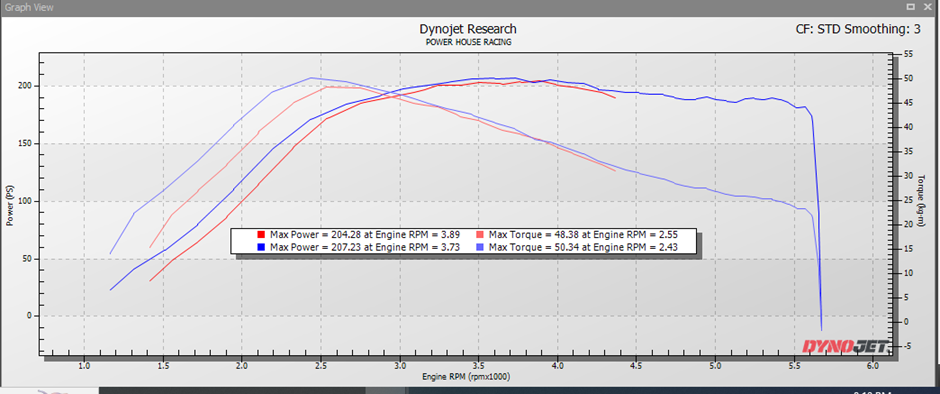
Octane booster itself does not create horsepower. But if an engine is losing performance because the ECU is reducing ignition advance, extra knock resistance may allow it to recover some of that performance. X-1R has an interesting example here. In dyno testing, maximum power increased from:
204.28 PS to 207.23 PS
That is approximately +2.95 PS, or +1.44%.
Maximum torque increased from:
48.38 kg·m to 50.34 kg·m
That is about +1.96 kg·m, or approximately +4.05%.
Does every car gain exactly that much? No.
Different engines, ECUs, fuel quality and test conditions produce different results, but it shows that an octane-related performance difference can be measurable.
But First, Does the Product Actually Raise Octane? This is arguably the more important question.
Some bottles advertise:
+5 Points!
+10 Points!
+30 Points!
Sounds impressive.
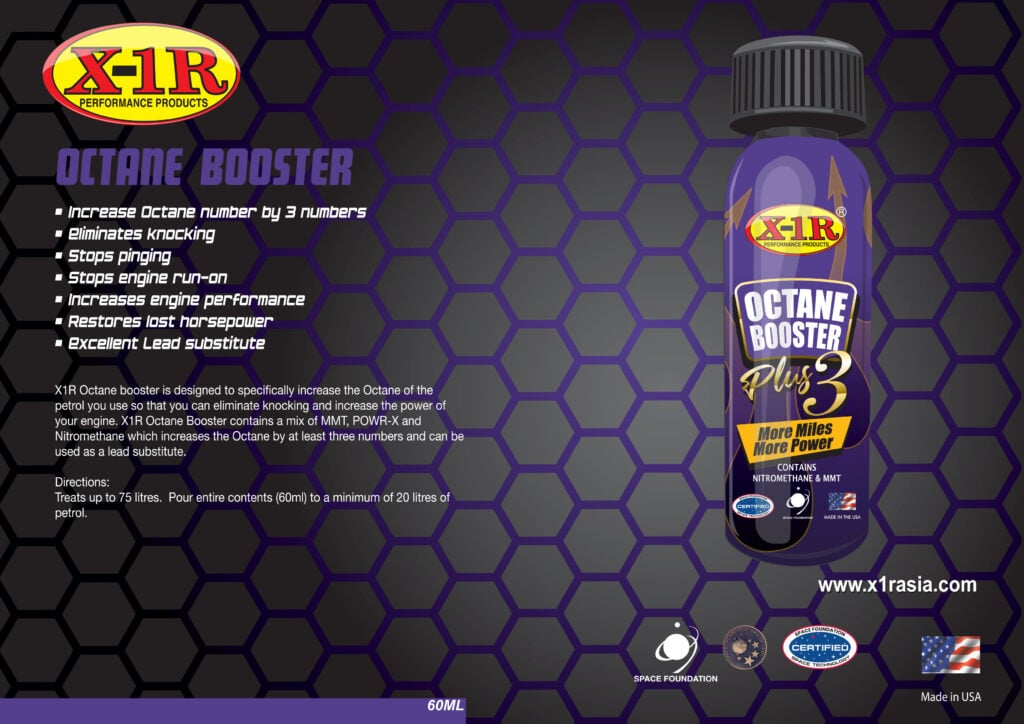
But octane “points” can be confusing. In some additive terminology, 10 points may equal roughly one full octane number. So rather than asking which bottle has the biggest number, ask:
What was the measured RON before and after treatment?
This is where X-1R has stronger supporting evidence. Published Intertek-Caleb Brett testing using the recognised ASTM D2699 RON method showed:
95.8 RON before treatment
and:
98.4 RON after treatment
That is a measured increase of +2.6 RON.
So the important story is not simply “Plus 3” on the bottle. The fuel was actually measured.
What About PHEVs?
Yes, octane can still matter. A PHEV may spend plenty of time running electrically, but underneath all that battery technology is still a petrol engine. When that engine suddenly starts during highway acceleration, hill climbing or low battery operation, it may be asked to work very hard.
If the PHEV uses a turbocharged or high-compression engine, knock resistance remains relevant. That does not mean every PHEV needs an octane booster. It means the electric motor does not cancel combustion physics.
So Who Should Consider One?
Octane booster makes the most sense for:
turbocharged cars, high-compression engines, performance vehicles, tuned cars, vehicles recommending premium fuel, and cars frequently driven under heavy load.
For a normal car perfectly happy on RON95?
Extra octane may do very little. And that is fine.
So, Is Octane Booster Snake Oil?
The category itself is not. Octane is real. Knock is real. Ignition retard is real and a genuine octane increase can be measured.
The better question is not:
“Which bottle promises the most horsepower?”
It is:
“Which product can prove that it actually raises octane?”

No supercar promises required. Sometimes the numbers are enough.